Evolutionary
Blindness and the
Spiritual Cosmos
A Synopsis of Redactive
Representational Pantheism
by David Clearwater
aided by Google Gemini
Redactive Representational Pantheism (RRP) is a philosophical framework that bridges the gap between evolutionary biology, cognitive neuroscience, and naturalistic spirituality. At its core, RRP posits that physical perception is not a clear window into objective reality, nor is it merely a flawed or limited biological instrument. Instead, our perception is a highly filtered, highly simplified representation of the external world, fashioned by evolution for the ultimate purpose of survival and functioning. According to RRP, the external world as it actually exists, unredacted and whole, possesses a profound, unbroken continuity, unity, and spiritual quality that qualifies it for the moniker of “God.” Yet, the necessity of human existence dictates that to live within this divine totality, we must remain functionally blind to its essential qualities.
Ultimate Reality: The Divine Substrate
To fully understand Redactive Representational Pantheism, one must first understand its foundational ontology. The label “Pantheism” within this framework requires a radical departure from traditional theology. God, in this context, is not an anthropomorphic deity sitting outside of space and time, possessing conscious thoughts, intentions, and moral judgments. Rather, God is viewed in the RRP framework as the totality of the ultimately unknowable external world in its unredacted state. It is the infinite, seamless continuity of the ultimate substrate of existence that appears in our redacted representational realities as the totality of matter, energy, and physical law.
The spiritual quality of this reality is personified in its absolute unity. In the unredacted external world, there are thought to be no true borders or boundaries between things. The atoms that comprise a human breath are inextricably linked to the atmosphere, the trees, and the distant stars. This continuous, unbroken field of existence is awe-inspiring in its infinite complexity and interconnectedness. However, because this unity lacks discrete boundaries, it is a reality in which in its naked bareness a biological organism cannot effectively operate.
The Mechanism of Exclusion: The Passive Redaction
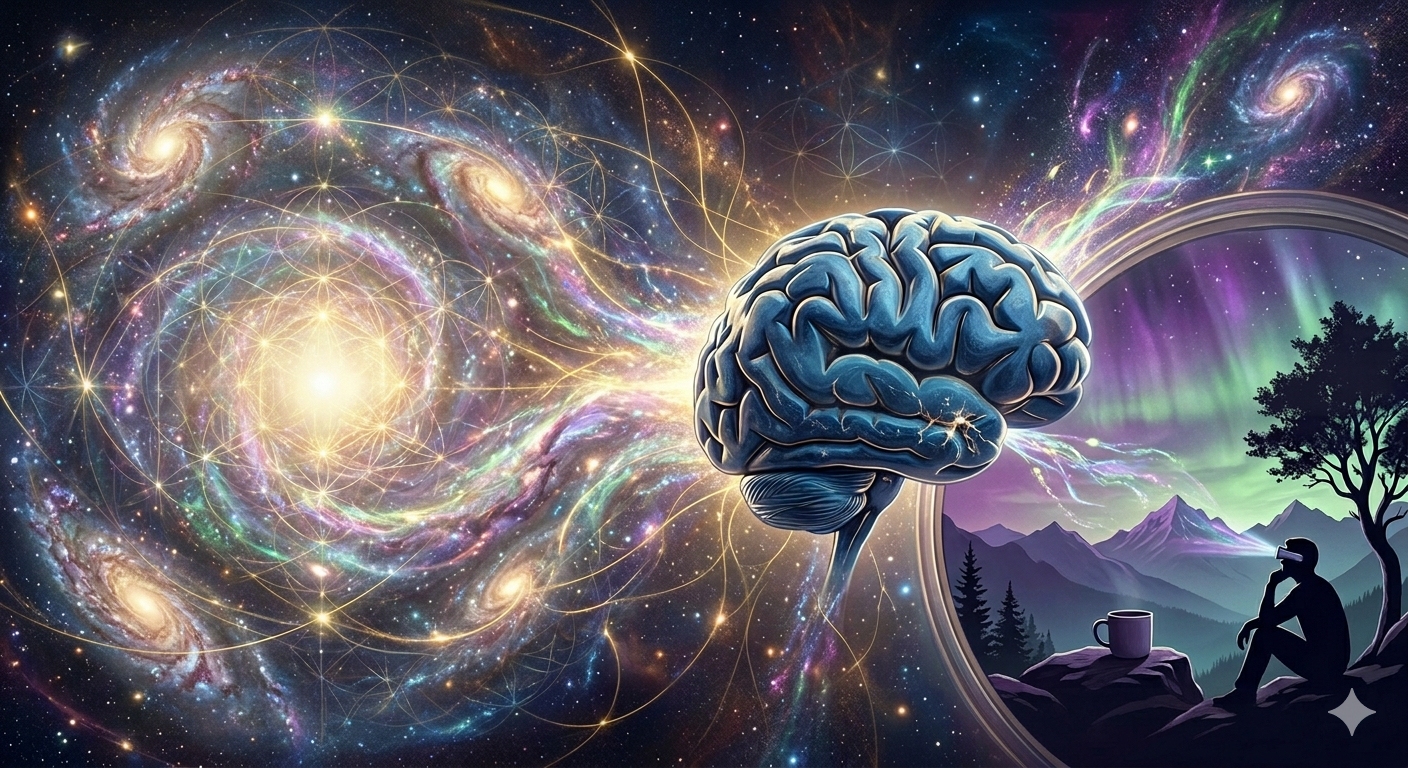
The brilliance of the brain and nervous system is not found in what it processes, but in what it ignores. This brings us to the “Redactive” pillar of the theory. Rather than perceiving the entirety of the external world and then consciously or deliberately censoring or editing it, the brain and sensory organs have evolved to perceive only what is essential to the survival and functioning of the organism, excluding or “passively redacting” the rest, which constitutes the vast majority of reality. This is a vital evolutionary adaptation. Processing the infinite complexity and unity of the divine totality would require an impossible amount of metabolic energy and would paralyze an organism with biologically useless information.
Evolution favors fitness over truth. For an organism to survive, find food, and avoid predators, it does not need to perceive the quantum fields vibrating beneath its feet or the unbroken continuity between its own body and the surrounding environment. It only needs to perceive actionable, functionally useful and survival-relevant cues. The brain is effectively a low-resolution filter, passively excluding the overwhelming majesty of the external world so that the organism can focus on immediate, practical navigation. Thus the redaction is not a biological flaw; it is the ultimate evolutionary aid.
The Inner Interface: The Mental Representation
Because the brain does not perceive the external world directly, what we are presented with is not reality itself, but a constructed mental model. This is the “Representational” aspect of the theory. The conscious experience we refer to as “reality” is merely an internal, highly customized representation generated by the brain and neurological system. It is a biological “user interface.”
The most profound illusion created by this representational interface is the concept of separation. Because the brain must interact with a unified universe, it fractures that unity into discrete, manageable objects. It creates the illusion of divisional edges, distinct colors, and separate entities so that we can successfully comprehend and manipulate our environment. A tree in its ultimate existence is not actually separate from the soil or the air, but our representational reality draws a firm line around it so we know we can use its fruit or hide behind its trunk.
Consequently, the most significant separation of all is the human ego, the concept of the “individual self.” To perceive oneself as a distinct, separate individual standing apart from the rest of the universe is the ultimate representational illusion. The feeling of individual isolation is thus the necessary price of biological autonomy.
Conclusion: The Paradox of Existence
Redactive Representational Pantheism ultimately presents a beautiful but perplexing paradox. We are made entirely of the divine, unbroken substance of the universe, yet the very biological mechanisms that allow us to live and breathe demand that we cannot fully and directly experience that unity. We exist within God, but we are limited by our own survival instincts to perceive only a fractured, redacted representation of that glory. Spirituality, under this framework, is the intellectual and emotional recognition of this massive, masked continuity—a humble acknowledgment of the infinite reality that sits quietly just beyond the veil of our senses.
Click here to return to the home page.
Copyright © 2026 David Clearwater