The Hawk’s Wing
Embracing a Reality That
is Wild, Open, and Unfinished
QBism Explained
Essay by David Clearwater
Aided by Google Gemini
Quantum Bayesianism, now more commonly known simply as “QBism,” represents a radical shift in the interpretation of quantum mechanics by moving the observer from the sidelines to the very center of the theory. Unlike traditional interpretations that treat the “wavefunction” as a physical object hovering in space, QBism posits that it is in actuality nothing more than a mathematical tool used by an agent to manage their “personal expectations.” This framework was born out of a desire to solve the persistent paradoxes that have haunted quantum physics since its inception in the early twentieth century. By redefining the nature of probability and the role of the scientist, QBism attempts to provide a consistent and logical path forward that avoids the need for multiple universes or faster-than-light communication. It essentially treats quantum mechanics as a “normative manual” for decision-making in a world that is fundamentally unpredictable. The result is a worldview that is deeply realist about the physical world while remaining strictly first-person in its mathematical application.
The genesis of QBism can be traced to the late 1990’s and early 2000’s, spearheaded by physicists Christopher Fuchs, Rüdiger Schack, and Carlton Caves. These thinkers were deeply influenced by the work of John Archibald Wheeler and his concept of a “participatory universe,” where the observer is an essential participant in the materialization of reality. They sought to refine the Copenhagen interpretation, which they felt was too vague about where the “quantum world” ends and the “classical world” begins. By adopting a subjective, or “Bayesian,” view of probability, they found they could strip away the “mathematical ghosts” that usually led to paradoxes. This transition marked a move away from seeing physics as a description of a static, finished “block” of space-time. Instead, they began to view physics as a tool for an agent to navigate a world that is “unfinished” and constantly being authored.
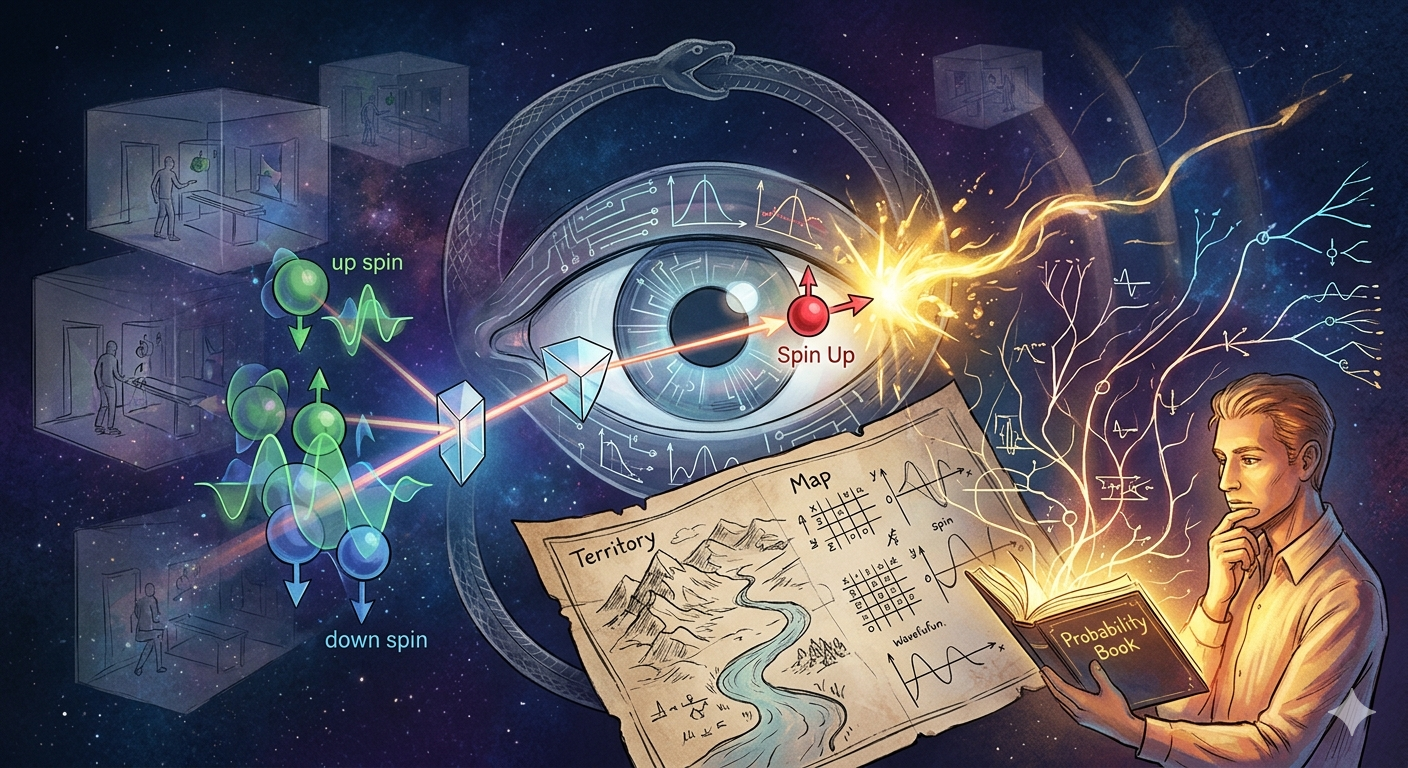
To define QBism accurately, one must first understand its core tenet: the wavefunction is not an objective property of a quantum system, but a personal “betting book” belonging to an agent. In standard physics, two people measuring the same electron are expected to agree on its state, or else one of them must be wrong. In QBism, two different agents can legitimately assign different wavefunctions or “probability maps” to the same system based on their unique information and experiences. This does not lead to chaos because the laws of quantum mechanics act as a set of consistency requirements that keep an agent’s beliefs logically sound. The “state” of the system is therefore not a fact about the particle, but a fact about the agent’s relationship with that particle. This radical subjectivity is what allows the theory to bypass the problem of how a wave physically “collapses” into a particle.
The intended purpose of QBism is to “save” quantum mechanics from the various absurdities that arise when one tries to view it as a “third-person” description of the world. One of the most famous of these is the “Wigner’s Friend” paradox, where two observers seem to disagree on whether a measurement has actually taken place. QBism resolves this by stating that a “fact” is only a fact for the agent who experiences it, meaning there is no single, objective “view from nowhere” to create a contradiction. This approach also eliminates the need for “spooky action at a distance,” which Albert Einstein famously found so troubling. If entanglement is just a correlation between an agent’s expectations, then measuring one particle doesn’t physically change another; it simply changes what the agent “expects” to happen next. By localizing the weirdness of quantum mechanics within the agent’s mind and not in the physical system being studied, the theory preserves the laws of relativity and the integrity of the local physical world.
A critical summary of QBism requires a focus on the concept of the “Kick,” which is how the theory maintains its claim to realism. Although the math is subjective, QBists argue that the world itself is very much real and independent because it “kicks back” when we act upon it. When a physicist performs an experiment, they are taking an action that elicits a response from nature that was not pre-determined or already contained in their mind. This reaction is a genuine, novel event that adds to the total content of the universe, suggesting that reality is a “work in progress” rather than a “finished machine.” This “participatory realism” ensures that the universe has a stubborn, external structure that exists regardless of our thoughts. Therefore, QBism is not a form of idealism, because it requires a real, physical substrate to provide the resistance that agents experience.
The role of probability in QBism is another essential pillar that differentiates it from almost all other interpretations of physics. Most scientists view probability as a physical “frequency,” such as the statistical likelihood of a radioactive atom decaying over a certain period. QBists, however, follow the school of Bruno de Finetti, who argued that probability is a purely subjective measure of an individual’s “willingness to bet.” From this perspective, the “Born Rule”—the famous equation used to calculate probabilities in quantum mechanics—is not a law of nature, but a law of thought. It tells the agent how they “should” organize their bets if they want to remain internally consistent with the structure of the world. This moves physics away from being a descriptive science of “what is” toward a normative science of “how to act.”
Genesis and purpose are further clarified by looking at how QBism handles the “measurement problem” that has long plagued the field. In traditional quantum theory, the transition from a “superposition of states” to a single definite outcome remains a mysterious physical process. QBism simplifies this by defining “measurement” as an act that an agent performs on their external environment to elicit an experience. The “collapse” of the wavefunction is nothing more than the agent “updating” their internal model based on a new piece of information. It is no different than a person seeing rain outside and instantly changing their “probability of rain” from fifty percent to one hundred percent. This removes the need for any magical or sudden physical transformation in the particles themselves.
The philosophical implications of QBism are vast, as they suggest a universe that is “malleable” and “wild” rather than mechanical and deterministic. Many interpretations of physics lead to a “Block Universe” where the past, present, and future are all equally real and fixed, leaving no room for true agency or change. QBism, by contrast, implies that the universe is actually a “pluriverse” where new facts are being created at every moment of interaction. This provides a “widening up” of the world, making the “first-person perspective” a necessary and irreducible component of reality. Instead of being accidental byproducts of a cold, mechanical cosmos, agents are seen as essential participants in the ongoing “birth of the world.” This restoration of meaning to the act of observation is one of the primary drivers behind the theory’s development.
Defending against the charge of “anti-realism” is a constant task for QBists, and they do so by re-centering the essential definition of what is “real.” They argue that theories like the “Many-Worlds” are actually less realist because they rely on infinite unobservable parallel universes to explain our local data. QBism remains grounded in the “here and now,” focusing only on the data that is actually accessible to a living observer. By rejecting the third-person “view from nowhere,” QBists believe they are being more honest about the limitations of human knowledge and the nature of science. They posit that objectivity is not a lack of observers, but the stability and agreement that emerges when multiple observers interact with the same stubborn world. This “intersubjective agreement” is what we eventually codify as the “laws of physics.”
In terms of its intended purpose, QBism also seeks to align physics with the lived experience of time and causality. In a deterministic quantum world, time is often seen as an illusion, but in a QBist world, the distinction between the “known past” and the “unpredictable future” is fundamental. Because the agent’s actions genuinely contribute to the future, there is a sense of chronological progression that matches our intuitive sense of life. This alignment makes the theory attractive to those who find the “clockwork” models of the universe to be emotionally and logically stifling. It suggests that the physical universe is not a lifeless object to be studied from a distance, but a “living partnership.” The “meaning” of the physical universe is thus found in the encounter between the agent and the environment.
Finally, to understand the “Future of Physics” as envisioned by QBism, one must look toward a world where physics, biology, and even psychology begin to overlap. If the observer is central to the theory, then the properties of the observer—such as their capacity for action and experience—must eventually be integrated into our broader scientific understanding. QBism does not claim to have all the answers about what the universe is “made of,” but it provides the open space for these questions to be asked. It moves from a “narrowing down” of reality into a single equation to a “widening up” of reality into an infinite set of possibilities. This transformative approach ensures that the “first-person perspective” is never again ignored in our quest to understand the nature of existence. By placing the observer back into the equations, QBism offers a vision of science that is both mathematically rigorous and profoundly human.
Click here to return to the home page.
Copyright © 2026 David Clearwater