Encoded
Awareness
Theory
A Short Introduction
by David Clearwater
aided by Google Gemini
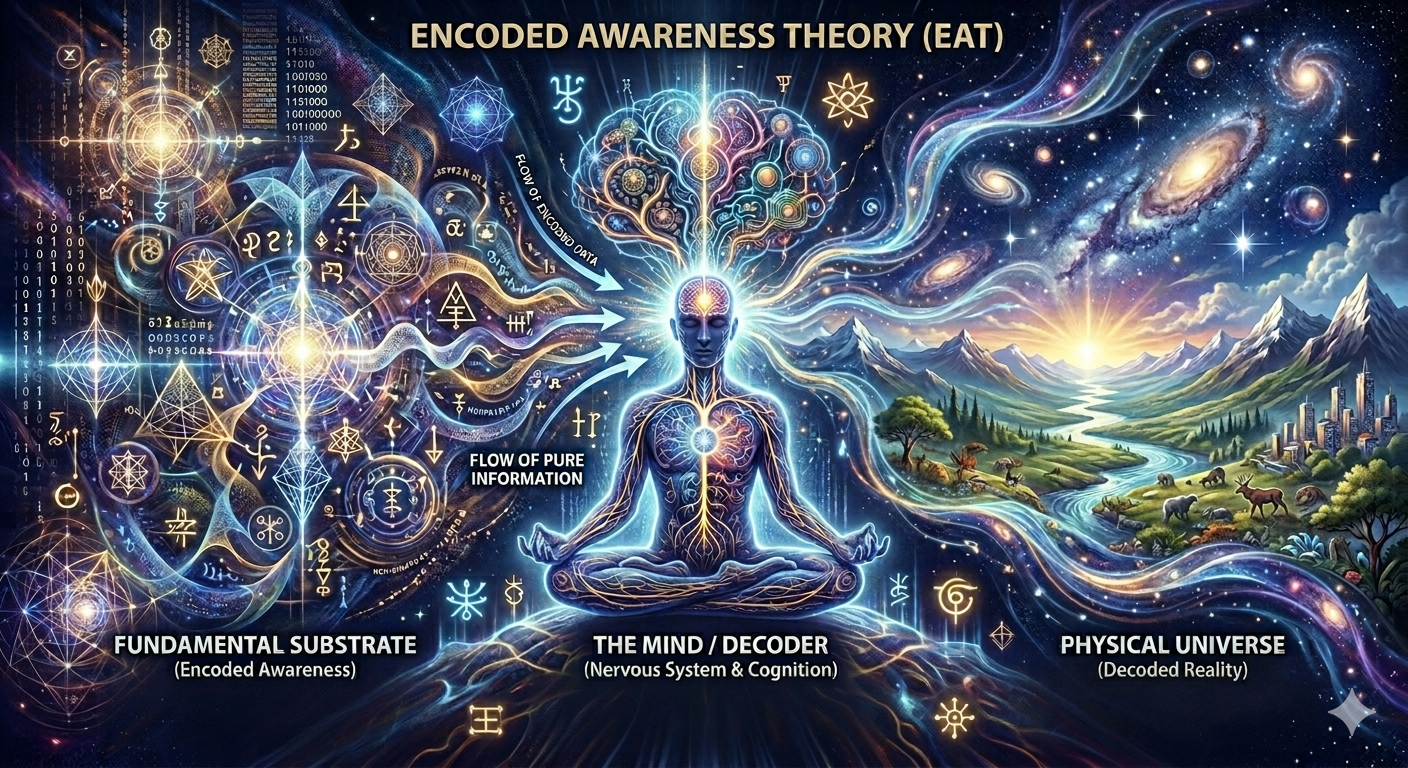
Encoded Awareness Theory, abbreviated simply as EAT, offers a profound reimagining of the fundamental nature of reality and our place within it. Unlike traditional materialist frameworks that view consciousness as a late-stage byproduct of complex biological machinery, this theory posits that the foundational substance of the universe is something known as “encoded awareness.” This underlying substrate is not composed of digital bits or discrete physical particles, but rather exists as a continuous, non-digital field of pure potential and information. In this paradigm, what we conventionally understand as the physical universe does not possess an independent, objective existence outside of our perception. Instead, the physical world is basically a constructed output, a functional fiction rendered by a decoding mechanism. Consequently, our perceived reality is fundamentally defined as “decoded awareness,” representing only a narrow, highly filtered slice of the much vaster, unseen whole. By repositioning awareness from an emergent phenomenon to the foundational bedrock of existence, EAT bridges the gap between subjective experience and objective ontology in a highly original manner.
To understand how this vast field of pure awareness becomes the specific reality we inhabit, one must examine the nature of the mind and the nervous system within this theoretical framework. According to EAT, the individual mind is not an entity separate from the substrate, but is rather a highly specific pattern existing entirely within the encoded awareness itself. This intricate pattern has been sculpted and refined over immense spans of time through the cosmic laws of biology and evolution. The nervous system functions exclusively as a sophisticated decoder, designed not to capture objective truth, but to translate the raw substrate into a biologically actionable format. Because this decoding mechanism was forged by the imperatives of survival, it is inherently optimized to prioritize safety and navigation over total ontological accuracy. Therefore, the conscious mind operates as a kind of evolutionary interface, selectively tuning into specific frequencies of the substrate while necessarily ignoring an infinite expanse of irrelevant data. The decoder essentially serves as a pragmatic filter, ensuring the biological organism is not overwhelmed by the infinite complexity of the underlying encoded reality.
The process of rendering reality begins at the sensory level, where the physical boundaries of the organism first interact with the fundamental substrate. In this initial stage, the biological senses act as a rapid translation mechanism, converting the raw, unadulterated encoded awareness into the basic building blocks of subjective experience known as qualia. This means that the profound redness of a setting sun or the sharp pain of a physical injury are not properties of an external world, but are rather the internal language of the decoder. The sensory organs perform a massive act of “lossy compression,” discarding an unimaginable volume of encoded data to present only what is immediately necessary for the organism’s functioning. Because the underlying encoded awareness is a continuous, non-digital state, this sensory filtering is required to impose a manageable structure onto an otherwise boundless field. The resulting qualia form the raw material from which all subsequent conscious experience is eventually forged. Without this aggressive sensory compression, the resulting influx of pure awareness would be entirely incomprehensible to the finite biological organism.
Once the sensory layer has successfully translated the raw substrate into manageable qualia, the cognitive faculties take over to perform a secondary, highly complex reconstruction. It is within this cognitive stage that the mind stitches together the disparate sensory data to project the coherent, three-dimensional illusion we call the physical universe. The mind infers depth, solidity, spatial relationships, and the thickness of the present moment, essentially building a high-fidelity simulation that the organism can seamlessly inhabit. Crucially, the physical universe produced by this cognitive rendering is fundamentally fictional, existing solely within the parameters of the decoded awareness. Furthermore, the cognitive layer is responsible for constructing the subjective concept of the “self” alongside the external environment. The perceived observer and the perceived external objects are both simultaneous functions of the exact same decoding algorithm. Ultimately, the subjective feeling of being an individual moving through a solid world is the masterpiece of the cognitive reconstruction process.
Because the physical universe is understood to be a functional fiction, Encoded Awareness Theory requires a radical reevaluation of how causality operates. We intuitively observe what appears to be physical cause and effect in our daily lives, such as a falling rock shattering a pane of glass. However, EAT asserts that true causality never actually occurs at the level of the physical reconstruction, but is instead entirely restricted to the domain of the encoded awareness. The physical interactions we perceive are merely the rendered interface displaying shifts and reconfigurations that occur entirely within the foundational substrate. When a medical intervention appears to heal a biological body, for instance, the true mechanism of healing is an informational restructuring within the encoded awareness itself. The resulting physical changes in chemistry and biology are just the secondary, decoded output of that deeper, unseen interaction. Therefore, every event in the reconstructed physical universe inevitably maps back to some corresponding informational change in the fundamental encoded reality.
The realization that causality is rooted entirely in the underlying substrate leads to profound implications regarding the limits of human knowledge and empirical science. Because our sensory and cognitive decoders are tightly constrained by evolutionary optimizations, there are inevitably vast regions of the encoded awareness that remain completely unmapped to our physical reality. This means there are countless causes and effects constantly occurring in the deeper substrate that simply have no corresponding representation in our decoded physical universe. An event or interaction might take place in the fundamental field of awareness without ever triggering a sensory translation or generating a physical artifact. Consequently, what we might perceive as entirely random occurrences or spontaneous phenomena in the physical world could actually be the visible endpoints of hidden causal chains. Traditional empirical science is thus fundamentally limited, as it can only study the mapped causality that successfully passes through the biological decoder or physical instrumentation.
While the biological decoder tightly governs our standard waking reality, Encoded Awareness Theory allows for profound exceptions in the form of altered states of consciousness and physical death. During intense meditative states, psychedelic experiences, or other profound shifts in awareness, the individual may temporarily bypass the standard sensory and cognitive filters. In these moments, the highly constructed fiction of the physical universe and the rigidly defined sense of self begin to rapidly dissolve. By circumventing the evolutionary interface, the localized pattern of the mind is able to experience the pure, raw encoded awareness directly. Similarly, physical death is not conceptualized as the ultimate end of existence, but rather as the disassembly and dissolution of the biological decoding mechanism. When the physical pattern dissolves, the localized awareness is no longer forced through the narrow bottleneck of sensory translation and cognitive reconstruction. The individual perspective ultimately returns to the unmapped, unfiltered state of the substrate, merging back into the infinite continuity of the foundational encoded substrate.
Ultimately, Encoded Awareness Theory presents a transformative lens through which to view the cosmos, shifting the locus of reality from cold, inert matter to a vibrant, continuous field of primary awareness. By reframing the biological mind and nervous system not as the generators of consciousness but as evolutionary decoders, the theory elegantly resolves the enduring paradox of how subjective experience seems to arise from a purely physical substance. Our perceived physical universe is understood not as an absolute truth, but as a deeply pragmatic, rendered fiction designed to help a localized pattern navigate a much deeper, unmapped causal ocean. This framework inherently humbles traditional empirical science by acknowledging its structural limitations, while simultaneously validating the profound insights of altered states as genuine encounters with the unfiltered substrate. Furthermore, by viewing physical death as merely the dismantling of a specific biological interface, the theory removes the finality of non-existence, suggesting instead a seamless reintegration into the infinite potential of the source. Encoded Awareness Theory invites us to recognize that we are not passive observers trapped in a mechanical universe, but rather localized expressions of the substrate itself, intimately engaged in the ongoing process of decoding its own infinite nature.
Click here to return to the home page.
Copyright © 2026 David Clearwater