The Refractive Prism
A Synopsis of Objective
Experiential Primism
by David Clearwater
aided by Google Gemini
I. Preface and Introduction
The traditional history of thought has long been fractured by a stubborn divide, a persistent chasm that separates the internal world of mind or consciousness from the external world of spacetime and matter. For centuries, we have struggled to explain how the silent, subjective spark of conscious awareness could ever arise from cold, unfeeling physical atoms, or conversely, how a non-physical “spirit” could move the gears of a material universe. Objective Experiential Primism, or OEP, emerges as an innovative solution to this ancient enigma by challenging the very roots of dualistic thought. It proposes that the confusion lies not in a lack of scientific data, but in our starting assumptions. We have been looking for the foundation of existence in either the “subject” or the “object,” when in fact, the only true reality is the interaction between them. By shifting our focus to this interface, we begin to see a universe that is fundamentally unified rather than split into opposing substances. This paradigm shift allows for a more coherent understanding of how consciousness and physical reality are inextricably linked from the very beginning.
II. Definition
At its core, Objective Experiential Primism is defined by three philosophical axioms that reorient our understanding of existence. It is called “Objective” because the medium of reality is not a figment of individual imagination but a shared, independent fabric that exists regardless of any single observer. It is “Experiential” because it posits that neither “mind” in itself nor “matter” in itself possesses independent reality; instead, only the relational interface between them—the “experiential medium”—is real. Finally, it is called “Primism” because it identifies this experiential medium as the primary constituent of the phenomenal universe. This reclassification moves experience from a late-stage biological byproduct to the very foundation of the cosmos. By establishing these three pillars, OEP provides a sturdy framework for exploring a reality where being and perceiving are two sides of the same coin.
III. The Medium Explained
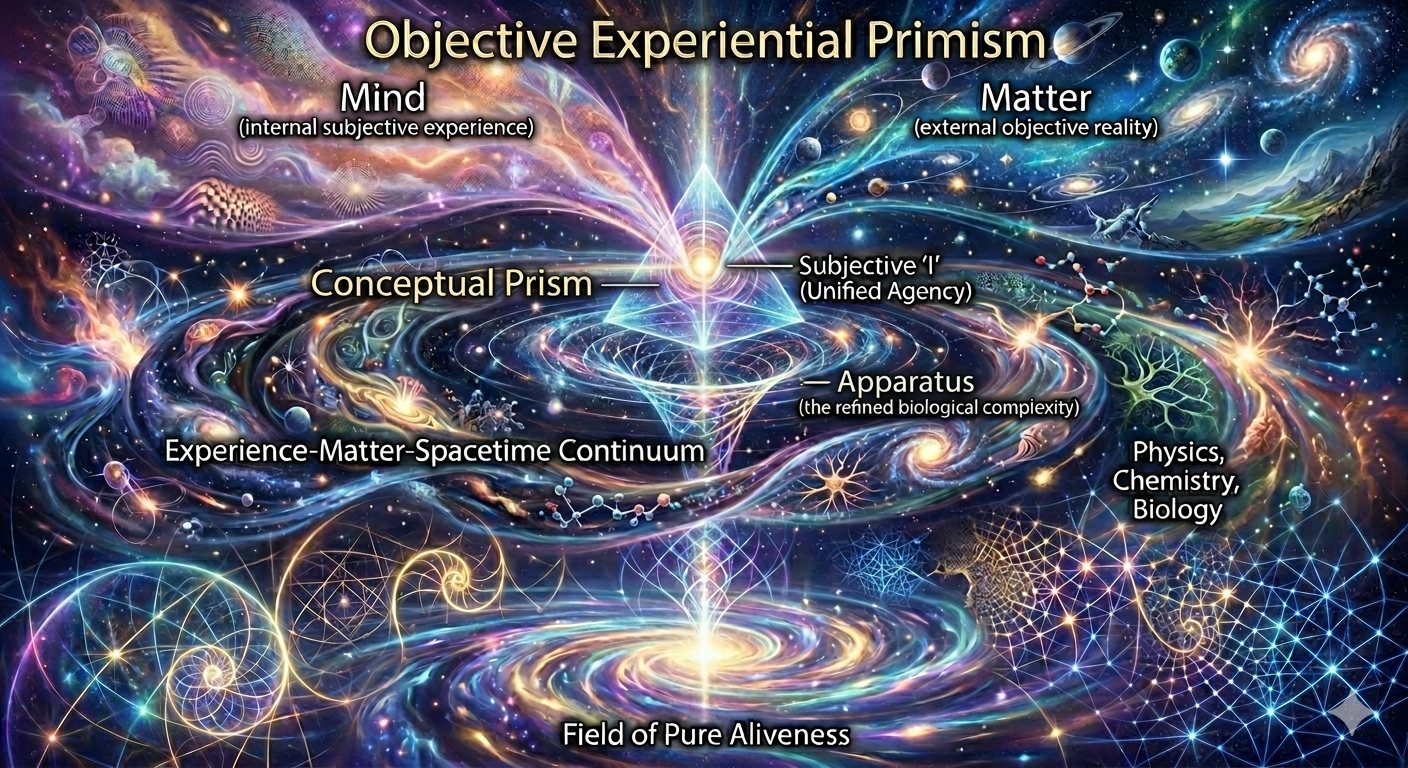
To grasp the mechanics of this theory, one must understand the experiential medium as an “experience-matter-spacetime continuum”. This continuum is not a static background or a solid stage upon which events occur; it is a living, dynamic process. In this unified system, “spacetime” provides the underlying spatial and temporal extension, “matter” provides the habitual stability of interaction, and “experience” provides the internal or subjective quality of the medium. They are not separate ingredients mixed together but are different qualities or aspects of a single, indivisible, unified and dynamic fabric. In this view, the universe is less like a collection of objects and more like a live performance where the actor, the stage, and the script are all manifestations of the same integrated movement. This perspective collapses the distance between the observer and the observed, suggesting that everything we perceive is a ripple in this singular, continuous medium. It implies that the physical laws we measure and the subjective feelings we endure are simply different ways of describing the same fundamental event.
IV. The Field of Pure Aliveness
While the experiential medium is the primary constituent of our manifest world, it is itself a psychophysical manifestation of an underlying “Field of Pure Aliveness”. This field serves as the absolute, fundamental reality from which all experience-matter-spacetime originates. It represents the source of all potentiality before it crystallizes into the structured forms of our daily experience. This field is not a place or a thing, but the ground of being that animates every aspect of the continuum. By positing this fundamental field, OEP suggests that the universe is inherently “alive” even in its most basic, pre-biological states. This original aliveness flows through the medium, providing the raw energy and potential that eventually organizes into the complex structures of the cosmos. Understanding this field is essential for recognizing that reality is not a lifeless, mechanical system, but a vibrant and continuous expression of living vitality.
V. The Natural Laws Explained
The experiential medium is governed by natural laws, such as physics, chemistry, and biology, which are not external constraints imposed upon the universe but are the inherent habits of the medium itself. These laws emerge from the Field of Pure Aliveness, acting as the first principles that allow the fundamental vitality to crystallize into a structured universe. Because these laws are ingrained in the medium, they represent the consistent ways in which reality interacts with itself. Furthermore, the laws of nature favor the development of complex conscious lifeforms, indicating a non-random directionality in cosmic evolution. Intelligent living beings represent the system’s ultimate teleological drive to consciously know and understand itself. As the medium follows these inherent habits, it naturally moves toward higher states of integration and self-awareness. This view reframes science as the study of the medium’s deeply ingrained behaviors and its inevitable journey toward consciousness.
VI. Fundamental Agency Explained
In Objective Experiential Primism, agency is not a sophisticated late-stage development of biological brains, but rather the primordial pulse of the experiential medium itself. Because the medium is the direct manifestation of the Field of Pure Aliveness, it inherits an intrinsic vitality that is fundamentally “deterministically unbound”. This agency manifests at the most microscopic levels as quantum indeterminacy—the inherent creative freedom of the medium to collapse potential futures into actual events. Rather than being a universe of passive, colliding parts, the medium acts as a participatory field where every interaction is a localized expression of this original creative power. It is not a blind, clockwork machine but a creative fountain of potential that constantly refreshes itself. This fundamental agency ensures that the universe remains open-ended and capable of genuine novelty. It suggests that choice and freedom are not illusions of the human mind, but refined versions of a power that exists in every atom of existence.
VII. The Apparatus Explained
As the laws of nature drive the medium toward greater complexity, the medium begins to organize itself into what we recognize as “apparatuses”. An apparatus, such as the human brain, is a complex neurological structure which serves a specific and vital function within the OEP framework. It acts as a psychophysical manifestation of the medium’s complexity, functioning as a funnel that concentrates the diffuse, microscopic agency of the medium into a unified, macro-scale “will.” This process of funneling generates the subjective sense of self, or the personal “I,” which we experience as a singular sense of individual identity. This identity is not a total illusion, but rather the “feeling of the unified agency” or the “internal readout” of the apparatus in action. Therefore, the self is a real, functional process—a localized “knot” of agency within the broader experiential medium.
VIII. The Emergent Concepts of Mind and Matter
When we navigate our daily lives, the apparatus projects the separate, distinct conceptual categories of “mind” and “matter” as navigational tools. This projection functions much like a prism that refracts a single beam of light into a spectrum of colors, making the unified medium appear as a polarity of two different substances. We perceive “matter” as the external, stable objects around us and “mind” as the internal, private thoughts within us. However, in the OEP view, these are simply helpful labels used by the apparatus to organize the raw data of the interface. This dualistic perception allows us to interact with our environment effectively, but it masks the underlying unity of the continuum. By recognizing these categories as conceptual projections, we can appreciate their utility without mistaking them for the fundamental nature of reality. True understanding requires looking past the refracted colors of the prism back to the singular beam of the experiential medium.
XI. Conclusion
In summary, Objective Experiential Primism offers a grand unified perspective where we are not observers separate from a material world, nor minds “trapped” in bodies. We are localized focal points of a living, dynamic, experiential and agential process that spans the entire cosmos. When we experience moments of profound flow or deep integration, the boundaries of the personal “I” dissolve into the background. These moments reveal that our individual agency is simply a concentrated expression of the agency that defines the entire experiential medium. We are not merely living “in” the universe; we are the universe experiencing itself through specific, complex experiential structures. This realization brings a sense of profound connection and purpose, as every thought and action is seen as a contribution to the medium’s ongoing evolution. Ultimately, OEP invites us to see ourselves as active participants in the eternal and vibrant dance of universal aliveness.
Click here to return to the home page.
Copyright © 2026 David Clearwater