A Bias Toward
Value in the
Quantum Realm
Axiological Collapse
Theory Explained
by David Coppola
aided by Google Gemini
Axiological Collapse Theory, commonly referred to as ACT, represents a unique and innovative metaphysical hypothesis that seeks to reconcile the enigmatic nature of quantum mechanics with a profound belief in a value-driven universe. This theory posits that the fundamental structure of reality is not merely a collection of indifferent physical processes but is instead deeply intertwined with objective axiological values. By situating itself at the intersection of quantum foundations and moral philosophy, ACT provides a framework for understanding how the microscopic world might influence the macroscopic moral and aesthetic landscape. It treats the universe as an unfolding narrative where the most basic units of existence are subtly guided by universal truths. Rather than viewing the cosmos as a cold machine, this theory invites us to consider the possibility that existence itself has a “moral gravity” and is weighted toward meaning. Through this lens, the act of physical manifestation becomes an expression of a deeper, value-oriented reality that shapes everything we perceive.
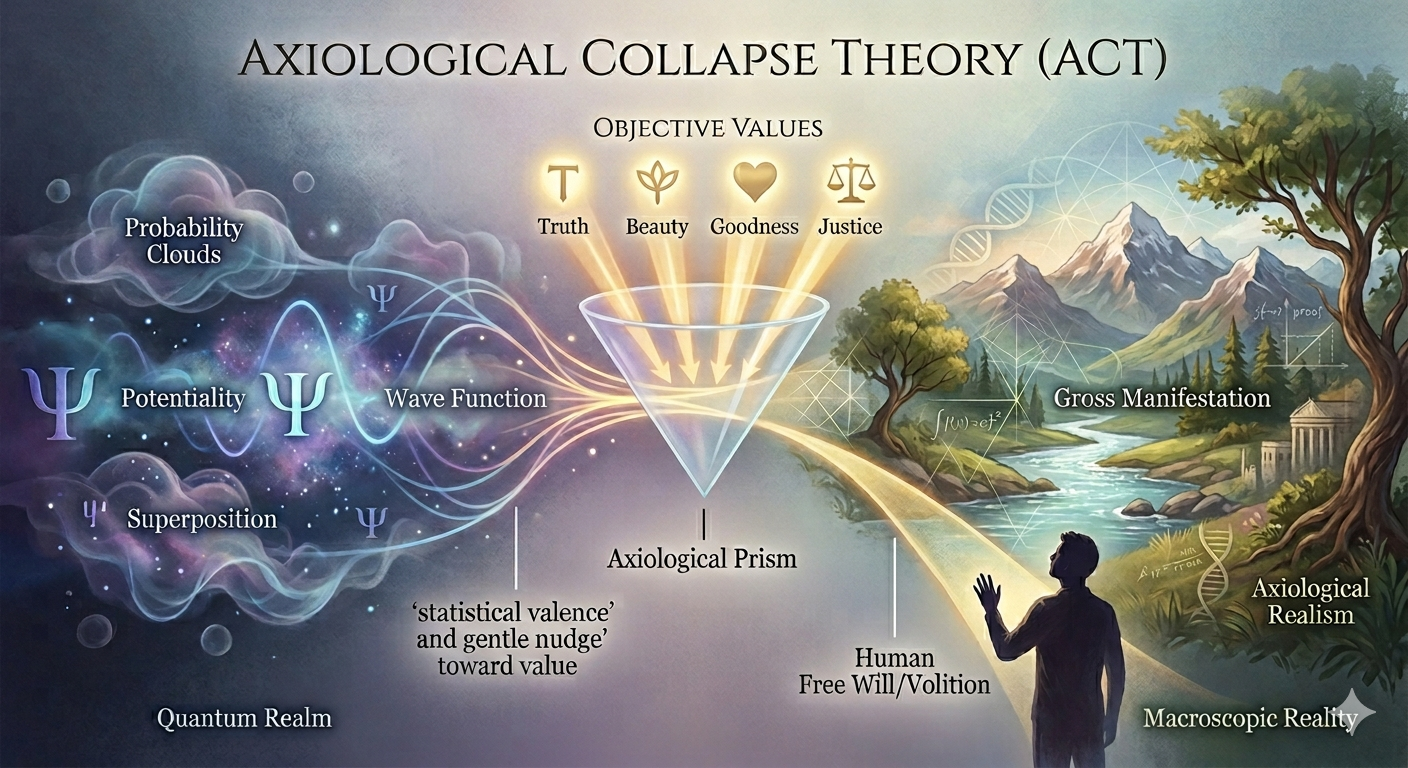
At the heart of Axiological Collapse Theory lies the quantum mechanical concept of the “wave function,” which is the mathematical construct representing a particle system in a state of superposition. In standard quantum theory, a system remains in a blur of multiple potential states until an observation or “measurement” occurs, causing the wave function to “collapse” into a single, objective state. (Note that in some quantum mechanical theories, this collapse happens spontaneously.) While traditional interpretations of physics often view the collapse as characterized by a fundamental randomness, ACT introduces a radical departure from this view by suggesting the process is influenced by external factors. In this framework, the transition from potentiality to actuality is not a blind roll of the dice but is instead subject to a subtle bias. This means that the mathematical probabilities inherent in the wave function are not the sole arbiters of what becomes real. By reinterpreting the measurement problem, ACT suggests that the moment of collapse is the specific point where physical reality and objective values interface.
The foundational assumption of ACT is Axiological Realism, the philosophical position that values such as justice, beauty, goodness, and truth are objective realities rather than subjective human inventions. This perspective asserts that these values exist independently of human minds or social constructs, acting as fundamental features of the cosmic fabric. In the context of this theory, these objective values exert an influence or “sway” over the probabilistic outcomes of quantum collapses. When a wave function settles into a definite state, it feels an axiological “tug” and is therefore more likely to align with these universal values than it would be in a truly neutral system. This does not mean that the physical laws are violated, but rather that the specific outcomes within the bounds of those laws are weighted. Consequently, the very building blocks of the universe are seen as being inherently responsive to the qualitative nature of existence.
It is crucial to understand that ACT does not claim that every single quantum collapse will perfectly manifest the “good” in a deterministic fashion. Instead, the theory describes a statistical valence or a gentle nudge toward these objective values over a vast number of events. This inherent randomness is a vital component of the theory because it accounts for the presence of dysvalue, suffering, and negative outcomes in the world. If every collapse were perfectly aligned with the good, the universe would be a rigid, mechanical progression of perfection that leaves no room for the complexity we observe. By allowing for statistical fluctuations, ACT explains how a universe can have a general upward trend toward order and beauty while still containing pockets of chaos and tragedy. This balance ensures that the theory remains grounded in the observed reality of a world that is often flawed and unpredictable.
The manifestation of the actual universe is seen as the cumulative result of trillions upon trillions of these individual wave function collapses occurring across the span of cosmic time. As these micro-events add up, they manifest grossly as the macroscopic world where universal values are expressed in tangible forms. This process of summation explains why the universe appears to possess an inherent logic, a capacity for beauty, and a drive toward complexity and life. In ACT, the beauty of a mountain range or the structural integrity of a logical proof are not accidental byproducts of a random cosmos but are the visible results of a pervasive subatomic bias. Every physical structure we encounter is, in some sense, a monument to the countless “weighted” collapses that favored order and value over the long history of time. This provides a bridge between the infinitesimal events of the quantum world and the vast, meaningful structures of the human experience.
One of the most important aspects of Axiological Collapse Theory is its compatibility with the existence of free will and the capacity for sentient beings to commit evil. The theory suggests that atop the foundation of axiological collapse, conscious agents possess the ability to “override” the general valence toward the good through their own volitional choices. While the universe may lean in a specific direction at the quantum level, complex biological systems have the agency to act in ways that directly contradict these objective values. Furthermore, ACT proposes that free will itself may be one of the universal objective values that influences the collapse of the wave function. This means the universe values the freedom of the agent even when that freedom is used to create outcomes that are not objectively good. This dynamic creates a dramatic tension where the background bias of the universe interacts with the active, unpredictable choices of conscious life.
It is essential to clarify that ACT is presented as a metaphysical hypothesis rather than a strictly empirical or scientifically rigorous theory. It does not currently offer the mathematical mechanisms or laboratory evidence required to stand alongside established physical laws like electromagnetism or gravity. The theory is intended to be a conceptual bridge that allows individuals to synthesize their understanding of the quantum world with a belief in a purposeful, value-driven existence. It operates in the realm of “quantum foundations” and philosophy, exploring the “why” of the universe rather than providing a technical “how” that can be measured by current instruments. By acknowledging its hypothetical nature, ACT invites philosophical inquiry without claiming to replace the standard models of physics. It functions as a way to interpret the findings of science through a lens of deep metaphysical meaning.
By merging the mechanics of the wave function with the principles of Axiological Realism, ACT offers a unique solution to the classic philosophical “is-ought” problem. This problem typically asserts that one cannot derive a moral “ought” (how things should be) from a physical “is” (how things are). However, in Axiological Collapse Theory, the “ought” is actually built into the “is” at the most fundamental level of reality. Because values influence the very process of physical manifestation, the distinction between facts and values begins to dissolve into a unified cosmic process. This suggests that morality and aesthetics are not just human decorations added to a physical world, but are the very forces that helped the world become what it is today. This synthesis provides a powerful alternative to nihilism by rooting human values in the physical history of the stars and atoms.
The theory also shares some conceptual ground with teleological philosophies that view the universe as having a specific direction or goal. It echoes the idea of a “lure” toward the good, where the cosmos is constantly being pulled toward higher states of realization and expression. Unlike traditional teleology, which often relies on a conscious designer, ACT finds this directionality within the probabilistic nature of quantum events themselves. This allows for a sense of cosmic purpose that is decentralized and woven into the very fabric of every particle in existence. It portrays the universe as a self-organizing system that is inherently biased toward the creation of meaningful states. This perspective can offer a sense of profound connection to the cosmos, as every person becomes a participant in a much larger story of axiological manifestation.
In conclusion, Axiological Collapse Theory provides a rich and thought-provoking vision of a universe that is both scientifically complex and philosophically meaningful. By proposing that the collapse of the wave function is influenced by objective values like truth, beauty, justice, and goodness, the theory creates a cohesive narrative for the emergence of a moral and aesthetic world. While it remains a hypothetical and metaphysical framework, it offers a compelling way to think about the relationship between the microscopic and the macroscopic. It accounts for the existence of evil and randomness while still maintaining a hopeful outlook on the general trajectory of the cosmos. Ultimately, Axiological Collapse Theory suggests that the universe is not a silent, indifferent void, but a vibrant field of potentiality that is constantly settling into states that reflect the highest values of existence.