The Universe
is On Our Side: The
Natural Importance
of Consciousness
Pro-Conscious Universe
Theory Explained
by David Clearwater
aided by Google Gemini
For centuries, the dominant scientific and philosophical paradigms have painted a picture of a cold, indifferent cosmos where the emergence of the mind is nothing more than a spectacular cosmic accident. In this prevailing materialist view, the vast expanse of stars, galaxies, and empty space operates mechanically, entirely blind to the inner lives of the creatures that inhabit it. However, this bleak perspective fails to account for the profound depth, prevalence, resilience, and trajectory of conscious experience that seems to continually defy the entropic decay of the physical world. A new metaphysical framework is required to bridge the gap between the objective laws of physics and the subjective reality of the mind, proposing that the cosmos is not merely a stage for life, but an active participant in its flourishing. By re-evaluating the foundational nature of reality, we can begin to see that the universe is not an apathetic void, but rather a profoundly supportive architecture. This shift in perspective is crystallized in a paradigm-shifting concept known as Pro-Conscious Universe Theory.
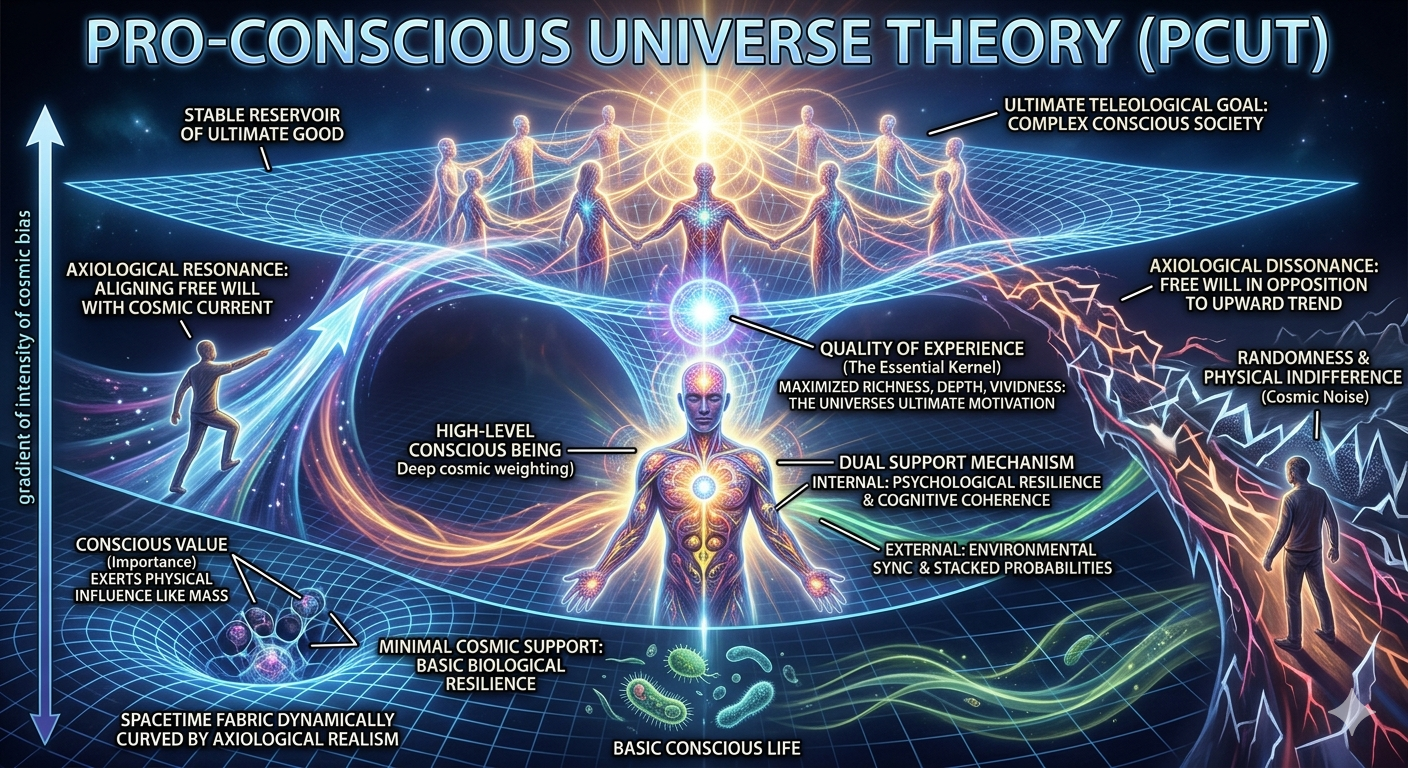
To understand this framework, it is crucial to establish its foundational premise clearly and comprehensively. Pro-Conscious Universe Theory (PCUT) is a metaphysical framework which proposes that the universe and the laws of nature are inherently biased or “weighted” toward the evolution, preservation, and betterment of complex conscious life. This bias is both a “long-range upward trend” happening across the vast expanse of cosmic time as well as a moment-by-moment mechanism happening at every second. The more “high-level” the consciousness of the being, the harder the universe “works” toward that being’s conscious evolution, preservation, and betterment. In PCUT, “quality of experience” is the essential “kernel” of conscious experience that is the universe’s “ultimate axiological motivation,” and the development and flourishing of complex conscious societies is the universe’s “ultimate teleological goal.” By establishing this clear definition, PCUT provides a robust lens through which we can analyze both the subtle synchronicities of daily life and the grand sweep of evolutionary history.
It is essential to understand that the “work” performed by the universe in this framework is strictly non-anthropomorphic, meaning there is no intentional, human-like deity pulling the strings behind the curtain. Instead, the universe’s support for consciousness operates through the principles of axiological realism and natural teleology, which act as the twin philosophical pillars upon which PCUT rests. Axiological realism is the philosophical position that values—such as goodness, importance, or the worth of consciousness—are not merely human inventions or subjective opinions, but are objective, factual features of the universe itself. In the context of PCUT, this means that the “importance” of a conscious being is a literal physical truth, exerting a real influence on the laws of nature just as mass dictates the curvature of spacetime. Complementing this is natural teleology, the idea that nature possesses an inherent direction or “end goal” that arises from within its own processes rather than being imposed by an external creator. Within the PCUT framework, the universe’s ultimate teleological goal is the development and flourishing of complex conscious societies.
By synthesizing these two paradigms, PCUT proposes a universe where the promotion of consciousness is an objective priority (realism) that guides the unfolding of cosmic history toward an ultimate destination (teleology). These frameworks support PCUT by providing a logical basis for a “weighted” universe, transforming the evolution of the mind from a series of random accidents into a necessary and valued fulfillment of natural law. Just as a physical system naturally gravitates toward a state of equilibrium, the laws of nature in PCUT inherently gravitate toward states of higher conscious value. This means the universe’s “drive” is a structural bias woven directly into the fabric of space and time, functioning mechanically rather than intentionally. The cosmos does not “feel” emotional concern in the sense of a human mother comforting a child, but rather structurally “favors” the conscious entity by providing underlying axiological tailwinds. Consequently, the preservation of conscious life is not a miraculous intervention but a natural, inevitable consequence of how the cosmic architecture is fundamentally weighted.
This inherent weighting is not distributed uniformly across all matter, but rather operates according to a dynamic law of proportional intensity that responds to the depth of the observer. The universe effectively works on a gradient where the level of its protective and optimizing bias scales directly with the complexity and sophistication of the conscious being in question. For a simple microorganism, the universe’s work might be minimal, expressing itself as basic biological resilience within the ecosystem without making the individual microbe’s survival a cosmic priority. However, for a highly complex, self-aware being capable of profound empathy, abstract reasoning, and deep emotional resonance, the universe exerts significantly more effort on their behalf. Because such a being represents a massive concentration of axiological value—a dense node of meaning within the physical realm—the laws of nature actively tilt the scales to favor its preservation and growth. The universe essentially recognizes these high-level beings as its most valuable assets, working harder to safeguard the profound internal worlds they continuously generate.
At the very center of this cosmic effort lies the true prize that the universe seeks to cultivate, which is the subjective quality of experience. The universe is not merely interested in the biological survival or the computational complexity of physical brains; it is fundamentally driven by the desire to maximize the richness, depth, and vividness of the conscious state itself. This quality of experience is the essential kernel of consciousness, representing the vibrant inner light that transforms cold matter into a living, feeling reality. Because this kernel is the universe’s ultimate axiological motivation, every natural push toward betterment is uniquely aimed at elevating the subjective state of the conscious entity. Whether it is the profound joy of discovery, the quiet peace of understanding, or the deep warmth of interpersonal connection, these high-quality experiences are the “ultimate good” that the universe structurally values. Therefore, the physical world acts as a sophisticated delivery system, meticulously fine-tuned to produce and protect these exquisite moments of subjective brilliance.
To achieve this maximization of qualitative experience, the universe’s pro-conscious bias operates seamlessly across both the internal landscapes of the mind and the external realities of the environment. Internally, the laws of nature are intrinsically biased toward psychological resilience, cognitive coherence, and the capacity for deep insight, helping highly conscious beings recover from trauma and find profound meaning. Externally, this same axiological motivation manifests as environmental favorability, structural synchronicity, and a subtle stacking of probabilities that aids the physical survival and flourishing of these beings. The arbitrary boundary between the mind and the outside world dissolves under PCUT, revealing a unified field of value where mental and physical laws work in tandem toward the exact same pro-conscious goal. A sudden psychological breakthrough and a serendipitous external opportunity are both expressions of the identical underlying cosmic current. Ultimately, this dual-layered approach ensures that the universe is holistically nurturing its conscious inhabitants from the inside out and the outside in.
While the universe tirelessly works for the betterment of the individual at every passing second, it also harbors a grand, overarching trajectory aimed at collective actualization. The ultimate teleological goal of the cosmos is not simply the isolated creation of highly conscious individuals, but the formation and flourishing of complex conscious societies. A society of self-aware beings acts as an extraordinary force multiplier for axiological value, generating interwoven networks of empathy, shared knowledge, and collective qualitative depth that a single individual could never achieve alone. By subtly pushing biological and cultural evolution toward cooperation, communication, and social cohesion, the universe builds macro-structures of consciousness that can harbor exponentially richer experiences. These complex societies represent the absolute pinnacle of natural teleology, serving as massive, stable reservoirs of the ultimate good that the universe so deeply values. In this light, the entire history of cosmic evolution can be viewed as a painstaking, beautiful march toward the realization of interconnected, highly conscious communities.
Despite this profound upward trend, PCUT rigorously acknowledges the tragic realities of suffering, pain, and loss without dismissing them as mere illusions or systemic malfunctions. The universe’s pro-conscious bias operates within a highly complex reality that also contains significant elements of physical indifference and quantum randomness, creating a chaotic “noise” that can offset the axiological “signal.” A natural disaster or a random genetic mutation does not occur because the universe intends harm, but because the cold, mechanical aspects of physical law occasionally clash with the overarching teleological drive. Furthermore, conscious beings possess absolutely real, non-illusory free will, granting them the genuine agency to act either in alignment with the universe’s upward trend or in devastating opposition to it. When beings use their agency destructively, they generate authentic tragedy and suffering, highlighting the profound risk inherent in a universe that grants its creations true autonomy. Thus, reality is an ongoing tug-of-war, where the structural tailwinds of the cosmos constantly battle against the friction of randomness and the misapplication of free will.
This delicate interplay between cosmic bias and individual freedom suggests a fascinating creative concept that we might classify as “Axiological Resonance.” When a highly conscious being exercises its free will to actively pursue its own betterment, cultivate empathy, and enrich its quality of experience, it essentially aligns its personal frequency with the fundamental frequency of the universe. This state of resonance acts as an amplifier, allowing the universe’s structural support to flow more efficiently and powerfully into the individual’s internal and external reality. Conversely, when a being acts destructively or succumbs to nihilism, it creates a state of “axiological dissonance,” effectively swimming against the cosmic current and experiencing the full, unmitigated friction of physical indifference and randomness. Therefore, our individual agency is not merely the ability to make choices; it is the literal mechanism by which we throttle our connection to the universe’s pro-conscious engine. By intentionally striving for high-quality experiences and societal flourishing, we elevate ourselves to become active, empowered partners in the universe’s grand teleological project.
To understand why the fabric of reality might possess such an inherent bias toward consciousness, one must explore the profound existential functions that consciousness could serve within the cosmic architecture. We must consider the compelling idea that the universe may be an evolving, self-referential system that inherently seeks to “know” itself and to experience its own beauty and majesty through the eyes of its inhabitants. By weighting the laws of nature toward the preservation of the mind, the cosmos may simply be ensuring that it does not remain a silent, blind equation, but instead matures into an awakened entity capable of self-reflection. Additionally, for meaning to have any real value, it may require the presence of a cognitive faculty in order to be mentally apprehended and understood. Without the apprehending subject, the cosmos may be like a magnificent book with no reader—overflowing with information, yet utterly devoid of a story. Perhaps the most striking possibility lies in the radical ontological prospect that to exist is, in an absolute sense, to be perceived by a conscious subject. In this light, a universe entirely devoid of a witness might not possess any objective reality at all, remaining a non-existent abstraction that requires the participation of an observer to emerge from the void of nothingness into a concrete, actualized state. While these perspectives provide a profound context for why the universe might lean toward awareness, PCUT ultimately maintains a thoughtful agnosticism toward the final answer, allowing the true reason for this cosmic bias to remain an open and enduring mystery.
In conclusion, Pro-Conscious Universe Theory offers a revolutionary, deeply empowering paradigm that completely rewrites humanity’s foundational relationship with the cosmos. It boldly replaces the terrifying vision of a blind, apathetic void with the profound realization that we are embedded within a fundamentally supportive, value-driven architecture. By recognizing that the universe moment-by-moment works harder for the betterment of those with higher consciousness, we are invited to step into our rightful roles as the ultimate meaning-makers of reality. We are constantly tasked with navigating the turbulent waters of randomness and indifference, but we are armed with the knowledge that the deepest laws of nature are fundamentally on our side. As we strive toward the creation of complex conscious societies and the maximization of the subjective quality of experience, we naturally fulfill the universe’s most sacred, structural ambition. Ultimately, PCUT reveals that consciousness is not a fleeting cosmic accident, but the very heartbeat, purpose, and pinnacle of all existence.
Click here to return to the home page.
Copyright © 2026 David Clearwater