The Tapestry of
Mind and Matter
An Introduction to
Psychophysical Fabric Theory
by David Clearwater
aided by Google Gemini
For centuries, the “hard problem” of consciousness has remained an impenetrable wall for philosophers and scientists alike. We have often struggled to explain how subjective experience can emerge from the cold, unfeeling movements of matter. Psychophysical Fabric Theory, or PPFT, offers a radical departure from these traditional dilemmas by suggesting that mind and matter are not separate entities at all. Instead, this theory proposes that consciousness is woven directly into the physical fabric of the cosmos from its very inception. This dual-aspect substrate, which we call the “psychophysical fabric,” integrates the mental and the physical as two sides of the same fundamental reality. By adopting this view, we stop seeing the mind as a strange intruder in a mechanical universe and start seeing it as an essential component of the cosmic weave. This shift in perspective transforms the universe from a dead machine into a living, integrated tapestry of being.
To define Psychophysical Fabric Theory accurately, one must first discard the notion that consciousness is a biological “extra” that only appeared late in evolutionary history. In the framework of PPFT, the psychophysical fabric is the singular substance of which everything in the universe is composed. Every “thread” of physical reality, such as a subatomic particle or a gravitational field, is paired with a corresponding “thread” of proto-conscious potential. These threads are not merely touching—they are fundamentally entangled and inseparable in a way that makes one impossible without the other. This means that even the most desolate regions of deep space possess a latent mental aspect, however quiet or dormant it may seem to us. Therefore, PPFT identifies consciousness as a primary, irreducible property of the universe rather than a secondary effect of complexity. It posits that the universe does not “have” a mind, but rather “is” a unified mind-matter continuum.
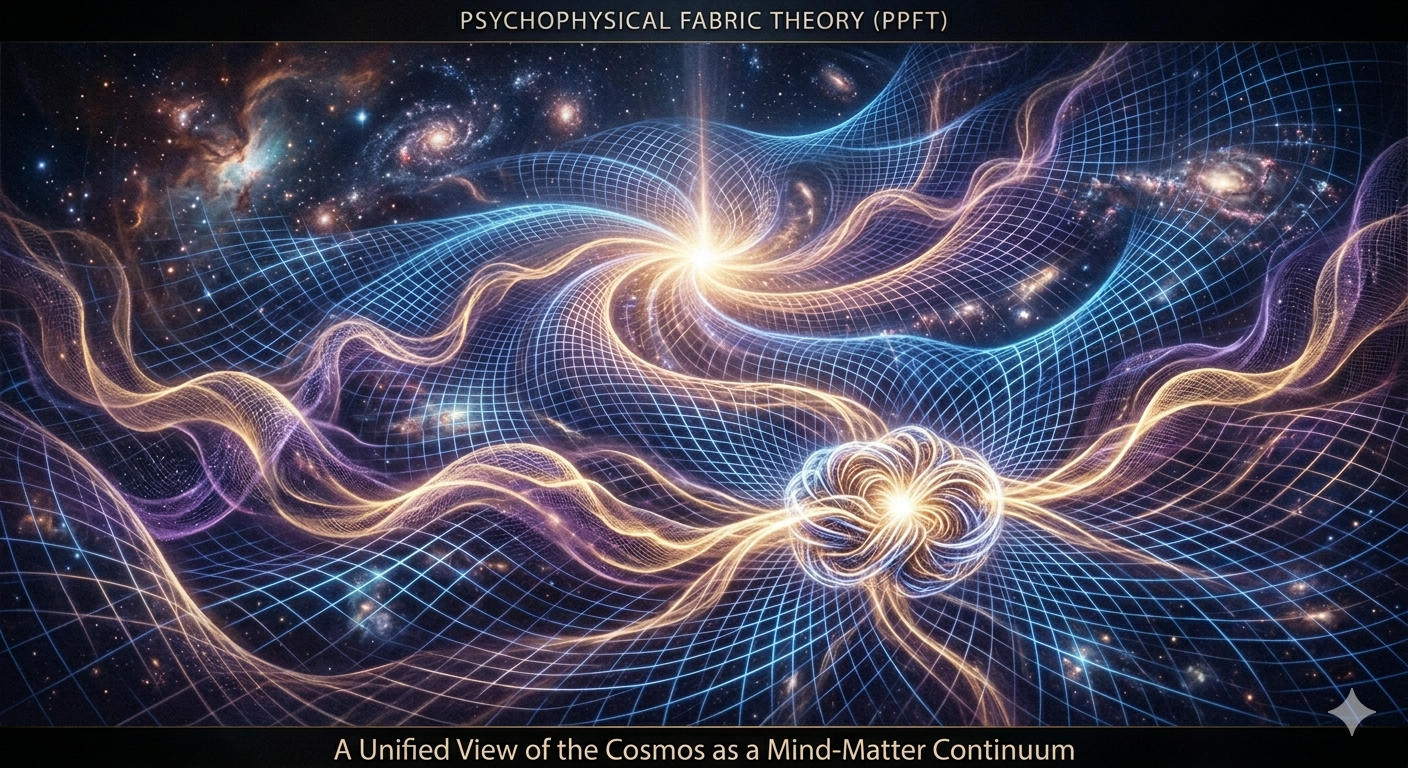
The choice of the word “fabric” is intentional and carries deep structural meaning for how we should visualize the interactions of the cosmos. Just as a piece of cloth is made of a warp and a weft that cross one another to create a unified surface, the psychophysical fabric relies on the constant intersection of the mental and the physical. The physical aspect provides the “tension” and the “structure” that we measure through mathematics and observe through our physical senses. Meanwhile, the mental aspect provides the “texture” and the “interiority” that we experience as thoughts, feelings, and perceptions. You cannot pull a single thread from this cosmic tapestry without affecting the integrity of the entire system, as they are part of one weave. This metaphor helps us understand that reality is not a collection of loose objects, but a continuous, integrated tapestry of existence. It suggests that our individual experiences are simply localized patterns on a much larger, universal garment.
When we expand our gaze to the cosmic scale, Psychophysical Fabric Theory transforms our understanding of the universe’s history and its ultimate nature. Instead of viewing the Big Bang as a purely physical explosion of energy, we must view it as the sudden unfurling of the psychophysical fabric. As the universe expanded, the mental and physical dimensions expanded together, ensuring that the “laws of mind” and the laws of physics remained in perfect sync. This cosmic perspective suggests that the universe is not a dead machine, but a medium that is inherently aware of its own structural state. Galaxies and star clusters are not just massive piles of gas and dust; they are vast, complex ripples in the psychophysical weave. Recognizing this cosmic unity allows us to feel a profound sense of belonging to a universe that is as much “mind” as it is “matter.” It suggests that the act of observation is simply the fabric looking back at itself through a specific fold in the weave.
Philosophically, Psychophysical Fabric Theory finds its roots in dual-aspect monism and certain forms of panpsychism, yet it carves out its own unique territory. While traditional panpsychism often suggests that little “bits” of mind are embedded into little “bits” of matter, PPFT emphasizes the absolute continuity of the fabric. It avoids the “combination problem” by arguing that consciousness doesn’t need to be “built up” from pieces because it is already a universal, underlying field. This approach aligns with modern field theories in physics, which treat particles as excitations in an underlying medium rather than isolated points. By treating the mental aspect as a field rather than a separate particle, we can explain how consciousness feels smooth and unified rather than fragmented. Consequently, PPFT serves as a bridge between ancient spiritual intuitions and the rigorous demands of contemporary theoretical physics. It offers a way to talk about the “soul of the universe” without abandoning the precision of scientific inquiry.
One of the most fascinating aspects of Psychophysical Fabric Theory is how it explains the high-intensity consciousness found in biological organisms like humans. We can imagine a brain not as a generator of mind, but as a specialized “knot” or a high-density convergence in the psychophysical fabric. Just as a heavy object warps the fabric of spacetime to create gravity, complex neurological structures “pull” on the psychophysical fabric to create a concentrated point of psychic awareness. This concentration allows the latent mental potential of the fabric to become active, self-reflective, and incredibly vivid. Smaller or simpler structures still exist within the fabric, but their “weave” is looser, resulting in a more diffused or “background” level of consciousness. This explains why we see a spectrum of awareness across the animal kingdom without having to invent a magical threshold where consciousness suddenly appears. We are simply the places where the universe has tied its most intricate and self-aware knots.
If we accept that the fabric is unified, we must consider the possibility of “psychophysical ripples” that travel across the cosmic weave. Just as a stone thrown into a pond creates waves, a powerful mental event or a collective human intention might create subtle deformations in the physical side of the fabric. This could provide a theoretical basis for phenomena that science currently struggles to explain, such as the strange coincidences we often call “synchronicity.” When a mental “thread” is tugged with enough force or resonance, it might naturally pull its physical counterpart into a specific, improbable alignment. These ripples would imply that the universe is not just reacting to our physical actions, but is also subtly responding to the quality of our internal lives. Such a feedback loop would mean that our thoughts are not private ghosts, but are active participants in the ongoing shaping of the physical world. It elevates the importance of our mental state from a private concern to a cosmic responsibility.
The existence of a unified psychophysical fabric suggests that the traditional boundaries of space and time may not limit consciousness in the ways we typically assume. Within this framework, phenomena such as telepathy and clairvoyant intuition can be viewed as interactions occurring across the mental dimension of the weave, where the “distance between minds” is mediated by the underlying substrate rather than purely physical separation. Similarly, powers of faith such as prayer and telekinetic healing might be understood as an intentional engagement with the fundamental entanglement of the fabric’s mental and physical threads, allowing for a localized influence that is structurally accounted for by the theory’s dual-aspect nature. Psychophysical Fabric Theory also provides a conceptual home for such phenomena as remote viewing or collective consciousness, suggesting that these are not disruptions of reality, but rather specific ways the fabric might fold or resonate with itself. While PPFT does not claim to define the exact mechanical “how” behind these occurrences, it identifies the psychophysical fabric as the essential medium that makes such non-local interactions possible. Consequently, the theory reframes these “psychic events” as natural, albeit subtle, features of a universe that is fundamentally a unified mind-matter continuum rather than a disconnected collection of isolated parts.
Another compelling extension of Psychophysical Fabric Theory is the idea that the psychophysical fabric might possess a form of “structural memory” within its weave. In this view, every significant event leaves a permanent “indentation” in the fabric, much like a well-worn path in a carpet. This could explain why certain places feel “charged with emotion” or why historical patterns seem to repeat themselves across different eras. We are not just living in the present; we are navigating a fabric that has been shaped and textured by every conscious moment that came before us. If the fabric remembers, then evolution is not just a biological process, but a process of the universe learning how to weave more complex patterns of experience. This adds a layer of depth to time, where the past remains structurally present as a lingering resonance in the psychophysical medium. Our lives become part of a permanent cosmic archive, etched into the very threads of existence.
Ultimately, Psychophysical Fabric Theory represents more than a mere academic hypothesis; it serves as a fundamental call to reconnect with the reality that sustains us. By dissolving the artificial boundaries between the observer and the observed, we begin to perceive a universe that is both mathematically structured and profoundly sentient. This perspective does not diminish the rigor of physical science, but rather enriches it by adding a dimension of intrinsic meaning to every measurement and discovery we make. Each of us exists as a unique expression of this cosmic weave, contributing our own specific texture and resonance to the ongoing story of the psychophysical whole. As we move forward, the adoption of this paradigm offers a path toward a more compassionate and integrated existence where the health of the human spirit and the state of the material world are understood as a single, unified concern. Ultimately, to embrace PPFT is to recognize that we are never truly separate or lost, as every thought we think is an integral pulse within the eternal, living fabric of the cosmos.
Click here to return to the home page.
Copyright © 2026 David Clearwater