The Naturally
Compassionate Heart
Compassionate Heart
An Exposition on
Civil Servant
Spiritual Philosophy
Civil Servant
Spiritual Philosophy
by David Coppola
aided by Google Gemini
aided by Google Gemini
Formal Definition and Introduction
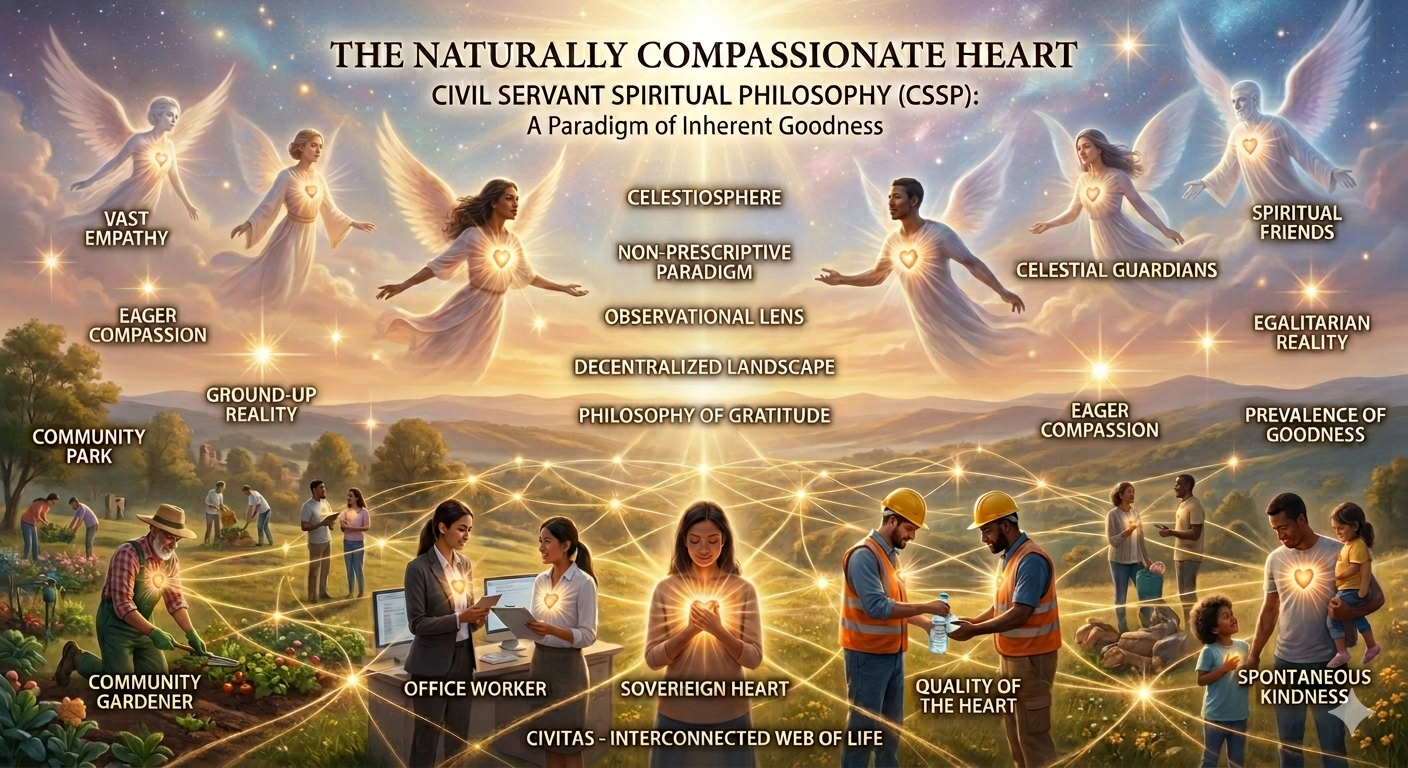
Civil Servant Spiritual Philosophy (CSSP) is a theoretical framework that identifies, honors, and reframes the innate prevalence of compassion, empathy, and altruism within the human and celestial experience. It is formally defined as a non-prescriptive paradigm that recognizes the “Civil Servant” as an abstract spiritual metaphor for any being—physical or non-physical—whose internal life is defined by a natural, high-frequency empathy for and desire to help all living things and the world as a whole.
Unlike traditional religious or ethical systems that seek to impose a moral imperative upon the individual, CSSP acts mainly as an observational lens. It does not attempt to change the world or organize human behavior into a system; instead, it provides a vocabulary for the spontaneous grace already present in the world and the celestiosphere. Rather than telling people what is “right” or what they “should” do, CSSP simply recognizes and celebrates the countless sovereign hearts who, out of their own free will and eager compassion, act as guardians and helpers for the collective liberation of all beings.
The Conceptual Foundation: Reframing the Existing Good
The primary purpose of CSSP is not to improve the world by imposing an ethical standard, but to offer a new way of looking at what already exists. It starts from the premise that we do not need to invent a new moral code to make the world better; we simply need to recognize the “prevalence of good people” who are already operating from a place of deep, instinctive kindness. By using the term “Civil Servant,” the philosophy takes a word often associated with cold governmental bureaucracy and redeems it as a celebrated spiritual archetype. In this context, “Civil” refers to the Civitas—the entire interconnected web of life—and “Servant” refers to a state of being where one’s ego is naturally inclined toward the well-being of that whole.
CSSP views the world in which Civil Servants are making a positive difference not as an “organized system” or a managed “spiritual agency,” but as a vast, decentralized landscape of goodness. It suggests that altruism is not a top-down requirement from a deity, employer, or government bureaucracy, but a ground-up reality. When we see a person acting with radical empathy, CSSP allows us to see them as a Civil Servant of the world’s heart. It transforms our perception of a chaotic world into one where, despite the challenges of existence, there is a constant and reliable presence of people who are independently choosing to hold the world together through their own compassion.
The Civil Servant as an Abstract Metaphor of the Heart
A central tenet of CSSP is that “Civil Service” is never a job title or a professional obligation. While the philosophy identifies that “natural altruists” often gravitate toward roles such as medicine, teaching, social work, or philanthropy, the philosophy is careful to state that the career is not the calling. The identity of a Civil Servant is found in the “quality of the heart,” not the “quality of the résumé.” One could be a high-powered executive, a quiet gardener, or a stay-at-home parent and still be a Civil Servant in the truest spiritual sense.
This distinction is crucial because it removes the “transactional” nature of service. In a professional setting, service is often performed in exchange for a salary or status. In CSSP, the “service” is a spontaneous internal radiation of kindness. It is a state of being where the heart is fundamentally open and available to the suffering and needs of others. This heart-quality is what defines the Civil Servant. It is an ontological state—a way of existing in the world where one’s primary resonance is one of empathy and compassion. By detaching the concept from the professional world, CSSP makes the archetype accessible to everyone, regardless of their station in life.
The Sovereignty of Choice and the Power of Eagerness
One of the most important aspects of CSSP is its emphasis on free will. A Civil Servant is never a “slave” to the spiritual needs of others, nor are they a martyr who helps out of a sense of exhausting debt or moral obligation. In many religious or ethical frameworks, service is depicted as a heavy burden that one must carry to be considered “good.” CSSP completely rejects this “weight-based” model of morality.
Instead, the Civil Servant acts out of a position of supreme autonomy. Their natural empathy and altruism create an internal “eagerness” to perform service. They do not help because they “have to” or are “directed to,” but because their heart finds its most natural and joyous expression in the act of helping. It is similar to how an artist feels a natural urge to create or a musician feels a natural urge to play; for the Civil Servant, compassion is their art. This eagerness ensures that the service is self-sustaining and authentic. Because it is a free choice born from a full heart, it carries a different spiritual “charge” than service performed out of a dry sense of duty.
The Rejection of Hierarchy and “Virtuoso” Thinking
CSSP is a deeply egalitarian philosophy. It intentionally avoids creating a hierarchy where some people are seen as “morally superior” or in a “different class” than others. While the philosophy acknowledges that figures such as Jesus or the Buddha were exemplary people who demonstrated an extraordinary depth of compassion, it does not see them as “Masters” or “Lead Servants” in a way that diminishes the common person.
In CSSP, there is no “virtuoso class” of spiritual beings. The kindness of a world-famous philanthropist and the kindness of an anonymous person helping a neighbor are seen as the same essential quality. By removing the “hierarchical duality” between the “great” and the “ordinary,” CSSP honors the commonality of the human heart. It suggests that we are all capable of the same Civil Service of the soul. No one is “better than” or morally superior to another; there are simply different expressions of the same altruistic frequency. This prevents the philosophy from becoming a tool for judgment and instead keeps it as a tool for universal appreciation.
The Celestial Guardians: A “Higher Fabric” of Protection
The vision of CSSP extends beyond the physical world to include the concept of “Celestial Guardians.” These are spiritual beings who inhabit the celestiosphere and who embody the same qualities of heart as human Civil Servants. Crucially, they are not part of a “heavenly bureaucracy” or “staff” following orders from a divine headquarters. Instead, these guardians are sovereign spiritual entities who, out of their own vast empathy and free choice, dedicate themselves to help all beings attain happiness and liberation.
These celestial helpers act as “guardians” in the same way a compassionate human might look out for a friend—not because it is their “job” in a celestial hierarchy, but because their natural state is one of protective love. They are part of a prevalence of goodness that exists across all dimensions of reality. By recognizing these beings, CSSP suggests that the universe is populated by “spiritual friends” of humanity who are independently working toward the same goals of healing and peace.
Conclusion: A Philosophy of Recognition, Not Imposition
Finally, it must be emphasized that CSSP does not try to impose an ethical standard on anyone. It does not tell people how they “should” live or what they “ought” to do. It recognizes that not everyone identifies with the Civil Servant archetype, and it does not judge those who do not. The philosophy simply “reframes” what is “already there.”
By looking through the lens of CSSP, we begin to see a world that is not just a collection of individuals looking out for themselves, but a world where there is a massive, decentralized prevalence of kind and benevolent hearts. It allows us to recognize the “silent infrastructure” of compassion that keeps society functional and life bearable. It is a philosophy of gratitude—a way of acknowledging the countless acts of eager, free-willed service that happen every moment, both on earth and in the celestial realms. CSSP reminds us that we are part of a world where goodness is a choice, empathy is a natural calling, and the heart is the ultimate authority.