Spiritual Continuism
A Unified Framework
for Bridging
Mind, Matter, and Spirit
by David Clearwater
aided by Google Gemini
Throughout the history of human thought, philosophers and mystics have sought to understand the ultimate nature of existence and the apparent divide between the spiritual and the physical. While classical dualism splits reality into distinct material and non-material domains, modern philosophical inquiry continues to seek a unified framework capable of resolving these ancient divisions. Out of this ongoing quest emerges a novel metaphysical architecture known as Spiritual Continuism (or just “Continuism” for short), which seeks to transcend traditional boundaries. Continuism is a metaphysical philosophy asserting that all existent phenomena—including physical matter, subtle spiritual entities, unseen worlds, and Source Consciousness—are continuous, interconnected manifestations of a single, unbounded, and seamless spiritual medium or energy structure called the “Continuum.” By framing reality through the lens of this unbroken energetic spectrum, this system bridges the gap between materialist science and spiritual experience. Consequently, it offers a holistic view of the cosmos that redefines our understanding of space, individuality, and divine presence.
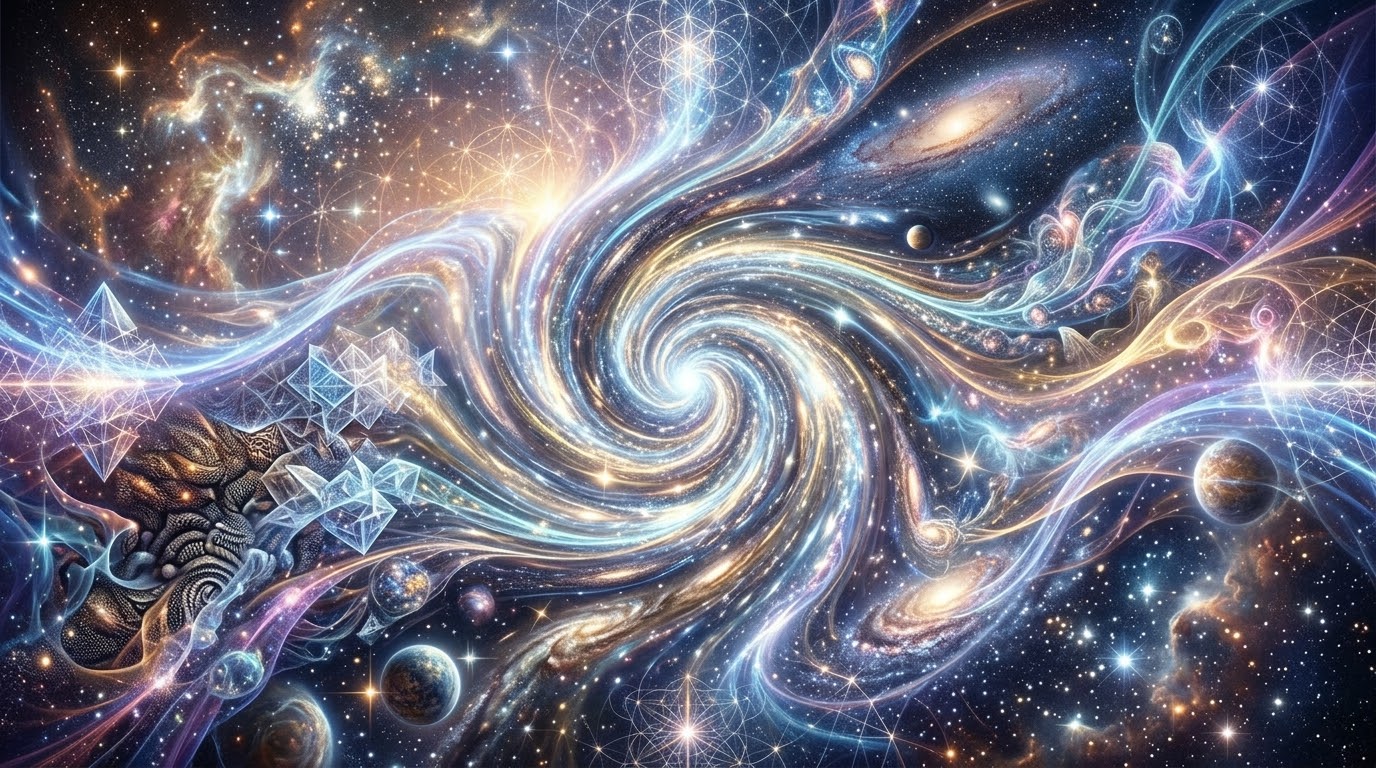
At the core of Continuism lies the foundational premise that empty space or fundamental separation between entities is an illusion born from limited human perception. Rather than viewing the universe as a vast void populated by isolated objects and distinct spirits, Continuism posits that a single, dynamic spiritual substrate called the Continuum fills and constitutes all of reality. This underlying medium functions as an expansive ocean of spiritual energy that expresses itself through varying states of vibration and compression. Within this framework, what physical science categorizes as dense matter is simply the Continuum condensed into highly localized, observable patterns. Conversely, unseen spiritual entities and intangible mental phenomena represent subtle, higher-frequency modulations of the exact same foundational energy. Thus, every atom, thought, emotion, and ethereal spirit shares a single ontology, existing as different textures within one continuous substance.
Central to understanding this philosophical paradigm is the redefinition of Source Consciousness, often referred to in traditional theology as “God” or the divine. In many classical monotheistic traditions, the creator is depicted as a transcendent entity existing separate from and outside of the created universe. Continuism fundamentally shifts this perspective by identifying Source Consciousness as the unmodulated, infinite, and foundational essence of the Continuum itself. Under this paradigm, the divine consciousness is not an external craftsman or distant observer, but rather the very fabric from which all existence is woven and sustained. Creation is therefore not an act of bringing something out of nothing, but rather a self-expression or modulation of the divine substrate into structured form. Because every part of the Continuum is intrinsically linked to its Source, every manifestation remains inherently imbued with the divine spirit.
A crucial question that arises within Continuism concerns how individual identity and localized awareness come to exist within an unbroken medium. If everything is part of a single continuous field, the human perception of isolated individuality requires a coherent explanation. Continuism resolves this by comparing individual conscious entities to localized vortexes or whirlpools forming within a flowing river. While a whirlpool maintains a recognizable shape, distinct movement, and localized boundaries, it remains entirely composed of the surrounding water and cannot exist independently of the river. Similarly, human minds and discrete spiritual beings are localized focal points of awareness within the broader Continuum, temporarily experiencing a bounded perspective. The sensation of fundamental separation is merely an artifact of perceptual focus rather than a true division in the underlying medium.
While Continuism shares significant common ground with nondualist philosophies such as Advaita Vedanta, it introduces key distinctions regarding the value of the physical world. Traditional nondualism often characterizes the material realm as an illusion or lower order reality that must be transcended to realize ultimate truth. Continuism, on the other hand, embraces an energetic substance monism that affirms the physical world as fully real and sacred. Matter is not seen as a veil obscuring reality, but as a valid, dense expression of the divine medium operating at a specific frequency. This perspective aligns remarkably well with quantum physics concepts, such as David Bohm’s implicate and explicate order, where observable forms unfold from a seamless holistic reality. By honoring both the physical and non-physical as equal aspects of a unified whole, Continuism provides a balanced synthesis of spiritual wisdom and contemporary systemic thought.
Ultimately, Continuism offers a compelling and cohesive framework for understanding the profound interconnectedness of all existence. By replacing the strict dichotomies of spirit versus matter and self versus other with a continuous spectrum of energetic expression, it re-enchants our understanding of the universe. It invites individuals to view themselves not as isolated spectators in a cold cosmos, but as active, localized expressions of an infinite divine field. This metaphysical model reconciles the tangible realities of physical life with the subtle realms of spiritual experience into a harmonious whole. As human understanding continues to evolve beyond rigid dualisms, Continuism stands as a promising paradigm for uniting science, philosophy, and spirituality. Through its vision of the all-inclusive Continuum, it reminds us that every aspect of reality is intimately bound to the singular divine heart of existence.
Click here to return to the home page.
Copyright © 2026 David Clearwater