Questioning the
Unobservable
An Inquiry into
Scientific Anti-Realism
by David Clearwater
aided by Google Gemini
Introduction
Scientific anti-realism represents a profound philosophical tradition that questions the extent to which scientific theories describe an objective, mind-independent reality, particularly regarding entities and processes that evade direct human observation. To properly understand anti-realism, it is necessary to first juxtapose it with its counterpart, scientific realism.
Realism vs. Anti-Realism
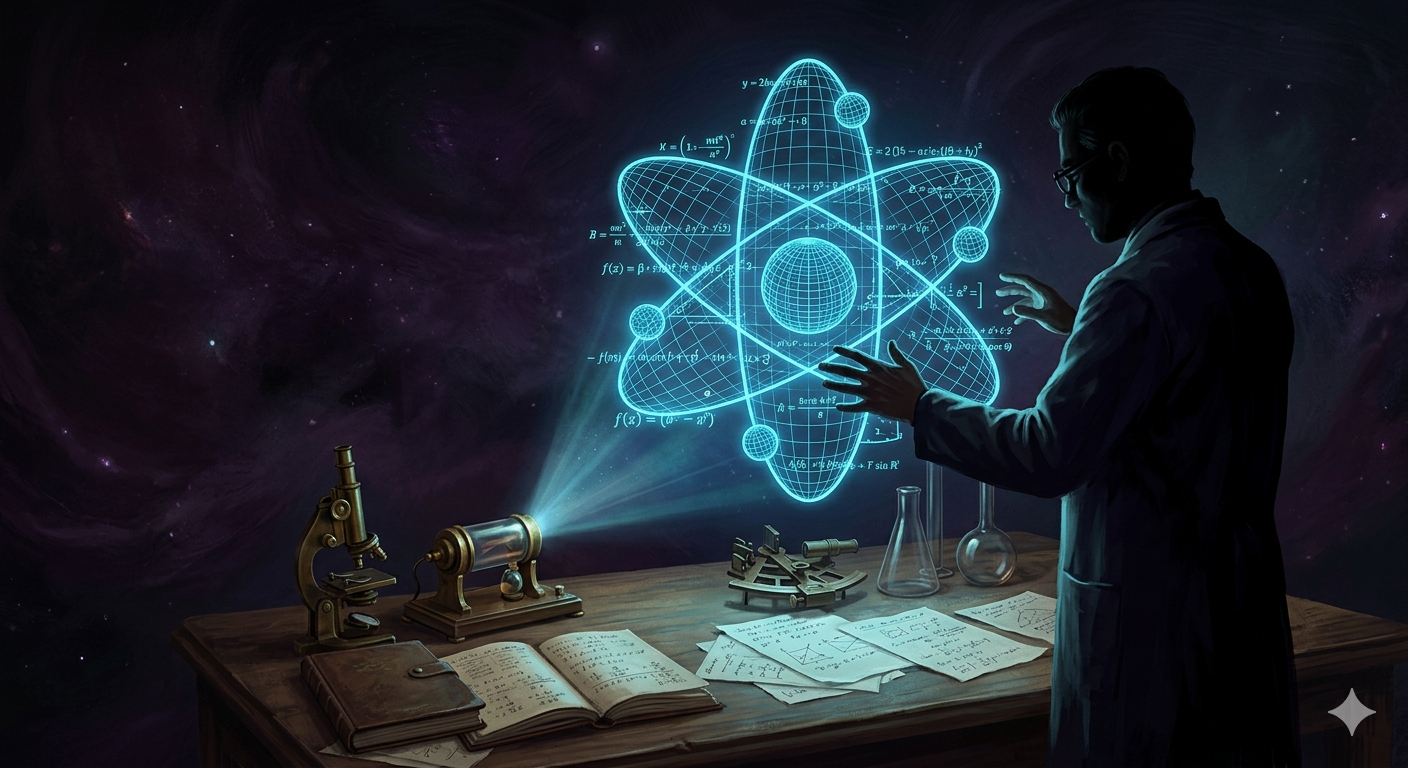
A realist maintains that the universe exists independently of human conceptual frameworks and that mature scientific theories provide a literally true account of both the observable and unobservable aspects of that universe. Consequently, for a realist, unobservable entities posited by modern science, such as quarks, electrons, and electromagnetic fields, possess a concrete existence exactly as described by the theoretical mathematics.
Anti-realists adopt a fundamentally different posture. They argue that the primary function of science is not to uncover hidden metaphysical truths about the fundamental fabric of reality, but rather to organize human experience, predict future observations, and provide practical tools for manipulating the physical world. In the anti-realist paradigm, the success of a scientific theory does not guarantee the literal existence of the unobservable mechanisms it describes.
The Pessimistic Meta-Induction
One of the most formidable arguments advancing the anti-realist position is known as the pessimistic meta-induction, famously articulated by philosopher Larry Laudan. This argument relies heavily on the historical trajectory of scientific inquiry. When examining the history of science, one observes a veritable graveyard of highly successful, widely accepted theories that were eventually discarded as completely false.
For centuries, the brightest scientific minds believed in the existence of phlogiston to explain combustion, the luminiferous aether to explain the propagation of light waves, and the caloric fluid to explain heat transfer. These theoretical constructs were not merely idle speculation; they were integral to theories that made incredibly accurate predictions, guided practical engineering, and formed the bedrock of the scientific consensus of their respective eras.
Yet, contemporary science universally acknowledges that phlogiston, aether, and caloric fluid do not exist. The anti-realist leverages this historical pattern to formulate a compelling inductive argument. If the overwhelming majority of historically successful scientific theories have ultimately been proven false regarding their unobservable entities, it is statistically and logically highly probable that our current best theories, including quantum mechanics and general relativity, will also eventually be superseded and revealed to be fundamentally incorrect at the unobservable level. Therefore, inferring the literal truth of a theory based solely on its predictive success is an epistemologically unsound leap of faith.
Major Philosophical Variations
Scientific anti-realism is not a monolith but rather a spectrum of viewpoints regarding how we should interpret scientific language and models. Instrumentalism, one of the earliest and most straightforward forms of anti-realism, posits that scientific theories are nothing more than sophisticated cognitive instruments or calculating devices. According to the instrumentalist, statements concerning unobservable entities do not even possess a truth value; they are neither true nor false, but merely useful mathematical fictions that allow scientists to bridge the gap between initial observations and predicted outcomes.
A more modern and nuanced iteration is Constructive Empiricism, championed by philosopher Bas van Fraassen in the late twentieth century. Constructive empiricism diverges from instrumentalism by acknowledging that scientific language should be interpreted literally. However, van Fraassen argued that the ultimate goal of science is not literal truth, but rather empirical adequacy. A theory is deemed empirically adequate if it accurately saves the phenomena, meaning it perfectly accounts for all observable data. Under this framework, a rational scientist accepts a theory because it is empirically adequate, utilizing its models and mathematical frameworks to advance research, but remains strictly agnostic regarding the literal existence of the unobservable entities the theory postulates.
Furthermore, the contemporary perspective known as Model Anti-Realism focuses specifically on the practice of idealization in modern science. Since modern scientific models, such as climate simulations or atomic models, explicitly rely on known falsehoods and simplifications to function computationally, model anti-realists argue that these constructs are best understood as intentional, pragmatic fictions rather than literal mirrors of nature. Additionally, in many fields it has been shown that radically different models can account for the exact same empirical data, pointing to the troubling conclusion that no single scientific model uniquely captures the true hidden architecture of the universe.
Comparing the Nuances of Scientific Philosophy
When comparing the nuances of these scientific philosophies, distinct differences emerge regarding the primary goal of science and the attitude toward unobservables. Scientific realism asserts that the primary goal of science is to formulate literal truths about the universe, demanding a belief in the concrete, independent existence of unobservable entities.
In contrast, instrumentalism views the primary goal of science as providing tools for calculating predictions, treating unobservables merely as useful fictions completely devoid of literal truth. Meanwhile, constructive empiricism posits that the goal of science is to achieve complete empirical adequacy, adopting an attitude of strict agnosticism where the acceptance of a theory does not require a belief in the unobservables it describes.
The Realist Challenge and the Anti-Realist Defense
The ongoing debate between realists and anti-realists frequently centers on the No-Miracles Argument, proposed by philosopher Hilary Putnam. Putnam argued that scientific realism is the only philosophy that does not make the incredible predictive success of science a completely inexplicable miracle. Realists contend that the sheer technological and predictive power of modern physics and biology can only be rationally explained if the unobservable entities they describe actually exist.
In response to this powerful intuition, anti-realists offer alternative explanations for scientific success that do not require an appeal to absolute truth. For instance, Bas van Fraassen utilized an evolutionary analogy, suggesting that scientific theories are subject to a fierce process of intellectual natural selection. Theories that fail to predict observations are swiftly discarded, while those that successfully map onto observable reality survive and propagate. Therefore, the fact that our current theories are highly successful is not a miracle, nor is it proof of hidden truths; it is simply the natural result of generations of scientists ruthlessly filtering out empirically inadequate models.
Conclusion
Ultimately, scientific anti-realism functions as an epistemic safeguard. It encourages humanity to fully embrace the magnificent technological and predictive power of the scientific enterprise while maintaining a profound philosophical humility regarding the absolute limits of human perception and cognition. By distinguishing the practical utility of a scientific map from the metaphysical reality of the territory, anti-realists remind us that the fundamental nature of the cosmos may forever remain partially obscured from the rational human mind.
Click here to return to the home page.
Copyright © 2026 David Clearwater