The Cartography
of the Infinite
An Introduction to
Cosmic Complexity Theory
by David Coppola
aided by Google Gemini
Throughout human history, our species has exhibited an undeniable drive to understand the cosmos, relentlessly seeking a unified framework that might explain the entirety of existence. We have constructed countless philosophical, spiritual, psychological, and scientific frameworks in our quest to find the ultimate answers to the deepest questions of reality. However, an inescapable frustration often accompanies this pursuit, as every totalizing framework eventually reveals its inherent limitations and contradictions. In response to this universal intellectual fatigue, a new paradigm has emerged to reframe our relationship with reality itself. Formally defined, Cosmic Complexity Theory or “CCT” is a philosophical meta-theory which asserts that the cosmos, life, and the human psyche are infinitely complex and therefore cannot be adequately distilled into a few or a handful of simple concepts, and that all theories, models, and worldviews which attempt to do so inevitably fall short of providing a sufficiently complete or accurate depiction of reality. By establishing this foundational premise, CCT effectively challenges the widespread assumption that a single, unified model could ever successfully encompass the boundless intricacies of the cosmos. It boldly suggests that our innate desire to reduce reality to manageable bites is the exact mechanism that blinds us to its true, unfathomable scale.
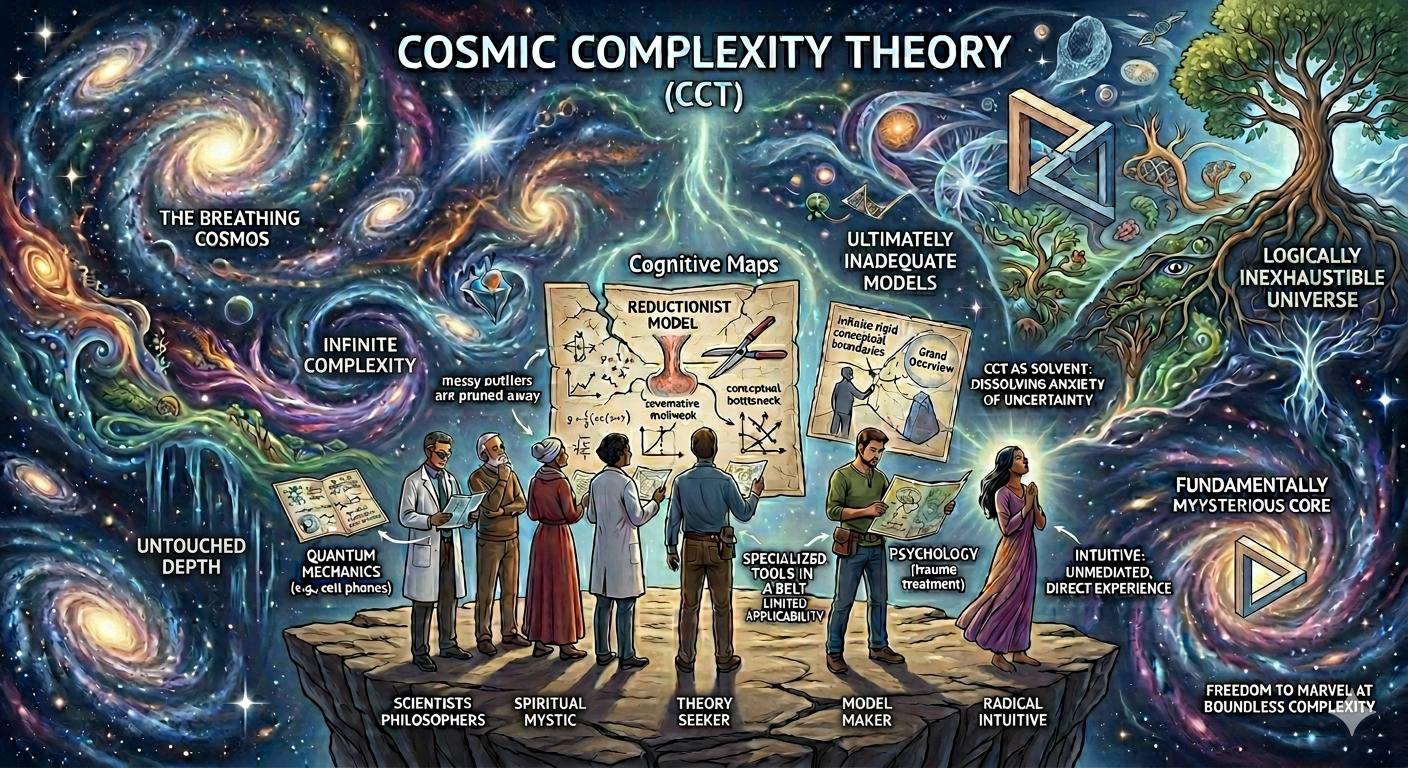
The traditional pursuit of a “grand overview” relies heavily on the process of reductionism, which attempts to distill sweeping universal truths into a handful of easily digestible axioms. Whether it takes the form of a physical equation attempting to unite all fundamental forces or a theological doctrine attempting to explain divine will, the goal is always to synthesize chaos and complexity into order and simplicity. Cosmic Complexity Theory identifies this distillation process as a critical bottleneck where the profound essence of reality is inevitably lost. In order for any model to remain clean, understandable, and logical, it must aggressively prune away the vast array of messy outliers and contradictory data points that constitute actual existence. Consequently, the clarity provided by these reductionist models is largely an illusion maintained by intentionally ignoring the infinite background noise of the universe. Any framework simple enough to be fully grasped by the human mind is, by definition, vastly too small to serve as a comprehensive explanation for everything that exists.
To understand why these distillation attempts fail, one must recognize the fundamental ontological gap between information and actual physical or spiritual reality. Cosmic Complexity Theory frequently utilizes the metaphor of cartography, reminding us that no matter how detailed a map may be, it can never completely describe the physical terrain it attempts to represent. Theories, equations, and worldviews are merely cognitive maps constructed from human language and logic, fundamentally separate from the breathing, dynamic substance of the cosmos. As we develop more advanced scientific, spiritual, philosophical, or psychological models, we undoubtedly fill in some of the blank white spaces on our maps, gaining valuable functional knowledge. Yet, the true terrain remains perpetually untouched by these efforts, maintaining its infinite depth regardless of how accurately we sketch its surface features. Therefore, the failure of our grand overviews is not a matter of needing more time or better data, but a permanent consequence of mistaking the paper representation for the living earth.
While some thinkers might suggest that we simply need to build messier, more complicated models to match the complexity of the universe, Cosmic Complexity Theory ultimately rejects this approach as well. It acts as a radical reaction against all theoretical models, recognizing that even the most contradictory and sprawling frameworks eventually hit a cognitive ceiling. A theory with thousands of interconnected variables might logically reflect reality better than a simple one, but it quickly becomes completely unusable and incomprehensible to the human intellect. Furthermore, even the messiest model remains a static snapshot attempting to capture an ever-changing, dynamic system, thus locking a fluid reality into rigid conceptual boundaries. Thus, attempting to construct an all-encompassing overarching theory is an act of intellectual overreach that misunderstands the fundamental nature of existence. CCT warns us that any model claiming to provide a complete and accurate picture of reality is suffering from an extreme case of intellectual hubris, regardless of whether that model is elegantly simple or overwhelmingly complex.
The realization that all models are ultimately inadequate often leads sincere seekers into a state of deep existential vertigo, characterized by feelings of hopelessness or intellectual claustrophobia. When individuals realize they cannot find a framework that seamlessly fits every aspect of reality, they frequently oscillate between rigid dogmatism, where they feel compelled to accept a limited and confining model, and despairing nihilism, where they categorically reject all models altogether. Cosmic Complexity Theory functions specifically as a “rescue theory” designed to save individuals from this exhausting and demoralizing cycle of theory-chasing. Rather than pointing to a flaw in the seeker’s intellect or a fundamental flaw in the universe, it validates their frustration by confirming that the puzzle they are trying to solve was never designed to be completed. This profound shift in perspective provides immense emotional and psychological relief, offering a viable “way out” for those who feel trapped by the limited selection of inadequate worldviews. It effectively transforms the perceived failure of the seeker into a beautiful recognition of universal richness, allowing individuals to accept the infinite without needing to conquer it.
Because it actively warns against the formation of grand totalizing structures, Cosmic Complexity Theory operates not as a building block for a new worldview, but rather as a powerful dissolving agent. If traditional belief systems are the rigid walls constructed to keep the terrifying unknown at bay, this meta-theory is the solvent that gently erodes those artificial barriers. It dissolves the anxiety of uncertainty, breaking down our desperate need for absolute correctness so that we might breathe freely in the open air of mystery. Importantly, believing in the inadequacy of all models does not require replacing old dogmas with a new, equally restrictive set of theoretical commandments. Instead, it acts as an ongoing intellectual practice, a higher vantage point that individuals can continually return to whenever they feel the gravitational pull of a totalizing system. By maintaining its identity as a solvent, the framework prevents itself from becoming the very thing it critiques, safely holding the space of “meta-belief” without collapsing into prescriptive dogma.
Despite its stark rejection of totalizing models, Cosmic Complexity Theory is entirely pragmatic and does not demand that we abandon the use of theories or models altogether. It acknowledges a clear order of accuracy among theoretical frameworks, noting that some are demonstrably “less wrong” and more useful than others, having “limited applicability” within their own specific domains. Quantum mechanics, for instance, is vastly superior to outdated atomic theories when it comes to developing technologies like cell phones and modern computers. Similarly, inventive psychological models are incredibly effective tools for treating trauma, even if they cannot explain the fundamental physical or spiritual origins of the universe itself. Granting us the freedom to utilize these limited models for their practical benefits, CCT allows us to treat them as specialized tools in a belt rather than infallible sacred texts. We can deeply appreciate and rely upon the functionality of science, psychology, spirituality, and philosophy, so long as we never mistake their localized successes for an adequate grand overview.
This pragmatic approach to utilizing specialized tools paves the way for what can be described as functional pluralism, where individuals are empowered to simultaneously inhabit the domains of empirical science, ethical philosophy, mystical spirituality, and introspective psychology without suffering from crippling cognitive dissonance. For those who are not naturally drawn to analyzing life through the lens of constructed models, Cosmic Complexity Theory offers an equally potent validation of their perspective. It champions the validity of radical intuition, suggesting that unmediated, direct experience of the world is a profoundly authentic way to engage with the cosmos. By honoring both the intellectual’s desire to use varied maps and the intuitive’s desire to walk the terrain without one, CCT embraces the vast diversity of human cognition. It elegantly decouples utility from ultimate truth, ensuring that everyone can find a legitimate way to navigate reality without compromising their intellectual or spiritual integrity.
Beyond serving as a dissolving agent, Cosmic Complexity Theory functions as a strategic philosophical “home base,” providing a unique and much needed safe haven for a diverse spectrum of thinkers. For the restless “theory seekers” who feel a deep, intrinsic pull toward finding a “Grand Overview,” CCT offers a secure and vital sanctuary where they can explore various frameworks without the crushing weight of having to find a “perfect” or “final” answer. Similarly, it provides immense relief for “theory makers,” allowing them to build, test, and refine their own conceptual models as creative or functional exercises while knowing that any inherent inadequacy is a reflection of the universe’s grandeur rather than a personal failure. These intellectual navigators are finally freed from the exhaustion of the “ultimate search,” enabled to use models as temporary tools rather than confining cages. Simultaneously, CCT provides an equally protective environment for “intuitives” who have always felt alienated by the societal pressure to adopt a formal worldview or a rigid system of belief. For these explorers of the naked terrain, CCT validates their preference for unmediated experience, affirming that their choice to walk through the mystery without a map is a sophisticated and grounded response to an infinitely complex reality. By acting as this cherished neutral ground, the theory provides a shared conceptual landscape where the specific approaches of seeking, making, and intuiting are all identified as functional responses to a reality that remains larger and more complex than any individual perspective.
In its attempt to address the entirety of human experience, Cosmic Complexity Theory skillfully reconciles the academic drive for knowledge with the spiritual recognition of the sacred. It characterizes the universe as logically inexhaustible, affirming that humanity can spend eternity making intellectual discoveries, refining theories, and cataloging new insights and information. At the exact same time, it openly acknowledges the spiritual element of reality, declaring that the cosmos is fundamentally and inescapably mysterious at its core. There are intrinsic qualities of existence, consciousness, and being that simply refuse to be tamed by human logic or successfully translated into the language of science and academia. By holding these two realities simultaneously, the theory bridges the historical divide between the dedicated scientist or philosopher and the contemplative mystic. It suggests that the universe is simultaneously a problem that we can joyfully work on forever and a profound mystery that we can only ever hope to inhabit.
Ultimately, the most distinguishing and liberating feature of Cosmic Complexity Theory is its steadfast refusal to moralize or prescribe specific behaviors to its adherents. It has absolutely no interest in dictating what people should or should not be doing or thinking, nor does it attempt to declare whether intellectual analysis or intuitive experience is the morally superior path. The sole ambition of this framework is to provide an objective diagnosis of our epistemological limits, explicitly acknowledging the inadequacy of all human-made worldviews. By simply offering a “higher view” for those who feel intellectually stuck, it grants individuals absolute sovereignty over their own minds and their own chosen paths through life. It provides a profound sense of peace by reminding us that the universe does not require our complete comprehension in order to remain beautiful, functional, and awe-inspiring. In letting go of the desperate need to cage the infinite within a single model or theory, we finally earn the freedom to marvel at the boundless, unmapped complexity of existence.