Centers of Density
Within the
Conscious Continuum
An Explanation of
Continuist Panpsychism
By David Clearwater
Aided by Google Gemini
Theory by Luke Roelofs
Throughout the vast and meandering history of human philosophy, the enigmatic nature of consciousness has remained one of our most profound and perplexing mysteries. For centuries, thinkers have wrestled with the “hard problem of consciousness,” struggling to explain how subjective, qualitative experiences can possibly arise from cold, inert, and non-conscious physical matter. Traditional dualism attempts to solve this by entirely separating the physical from the mental, while strict materialism often attempts to reduce the mind to a mere illusion or byproduct of neural mechanics. In response to the persistent shortcomings of both of these orthodoxies, modern philosophy has seen a fascinating resurgence of panpsychism, the ancient view that consciousness or subjectivity is a fundamental and ubiquitous feature of the physical universe. However, acknowledging that consciousness permeates the cosmos only replaces the mystery of origins with a new set of structural dilemmas regarding how minds exist and interact. To address the intricate mechanics of a conscious universe, contemporary theorists have developed highly sophisticated frameworks to map the very architecture of reality, leading to groundbreaking and elegant new perspectives.
Among these emerging perspectives, a highly compelling and innovative theory known as Continuist Panpsychism has garnered significant attention for its elegant resolution to longstanding philosophical roadblocks. Continuist Panpsychism, often simply called “Continuism,” was formally developed and articulated in contemporary philosophical discourse by the philosopher Luke Roelofs. The theory provides a powerful alternative to the idea that the universe is filled with tiny, isolated, and disconnected fragments of consciousness residing in individual particles. Formally defined, Continuist Panpsychism is a cosmological framework proposing that phenomenal consciousness exists as a single, unbroken, and boundless field that spans the entirety of the universe, without any intrinsic metaphysical boundaries dividing it into discrete subjects. In this paradigm, the fundamental fabric of reality is inherently experiential and continuous, meaning that the capacity for subjective experience is not chopped up into separate “blocks” but flows seamlessly across all of existence. By redefining the spatial and structural nature of the mental landscape, Roelofs invites us to view the cosmos not as a crowded room of isolated minds, but as a singular, undivided ocean of pure awareness.
To truly appreciate the necessity and ingenuity of Continuism, one must first understand the frustrating philosophical obstacle it was designed to overcome, which is famously known as the “combination problem.” Standard micropsychism, the most common variant of modern panpsychism, posits that fundamental particles like quarks and electrons possess an extraordinarily basic, primitive sliver of consciousness. The combination problem asks a seemingly unanswerable question: How can billions of these tiny, distinct, and completely separate “micro-minds” ever merge to form the single, unified conscious experience of a human being? It seems fundamentally impossible for a collection of distinct subjects of experience to combine their subjective viewpoints into one seamless “macro-subject,” just as putting a hundred people in a room does not create a giant, collective “super-mind.” This conundrum has historically been the greatest stumbling block for panpsychism, leading many critics to dismiss the entire movement as inherently flawed and logically incoherent. Continuist Panpsychism entirely circumvents this seemingly intractable puzzle by denying the very premise that consciousness starts out as discrete, fragmented pieces that need to be glued together in the first place.
The foundational axiom upon which Continuism builds its worldview is the principle of phenomenal unboundedness. This principle asserts that within the fundamental layer of conscious experience itself, there are absolutely no strict edges, walls, or metaphysical boundaries separating one space of awareness from another. Just as the spacetime continuum is generally understood by physicists to be a continuous and undivided fabric stretching across the cosmos, the phenomenal continuum operates in exactly the same unbroken manner. This means that at the deepest metaphysical level, the subjective experience happening right now in your mind is continuous with the subjective experience of the space around you, extending endlessly outward. Phenomenal unboundedness demands a radical shift in our intuition, forcing us to abandon the comforting but illusory notion that our minds are completely sealed off in hermetic containers. Instead, it asks us to visualize a universe where the “what it is like” aspect of existence is a universal continuum, a pervasive and seamless medium in which all mental and physical events take place.
If consciousness is truly a single, undivided field spanning the universe, an immediate and glaring contradiction arises regarding our everyday human experience. We must inevitably ask why, if consciousness is a continuous web, our individual minds feel utterly separate from one another and completely incapable of experiencing the thoughts or feelings of our neighbors. Continuism masterfully resolves this tension by introducing a second crucial axiom: the principle of informational separateness. While the underlying phenomenal medium of consciousness is entirely unified and continuous, the actual processing, flow, and exchange of information within that medium is strictly constrained by physical mechanics. Your brain and the brain of the person sitting next to you do not share any direct neural pathways, synaptic connections, or informational bridges, meaning data cannot freely pass between your respective cognitive systems. Therefore, the isolation and individuality we feel is not an isolation of conscious existence itself, but rather an isolation of informational access, creating a localized blind spot within the universal field.
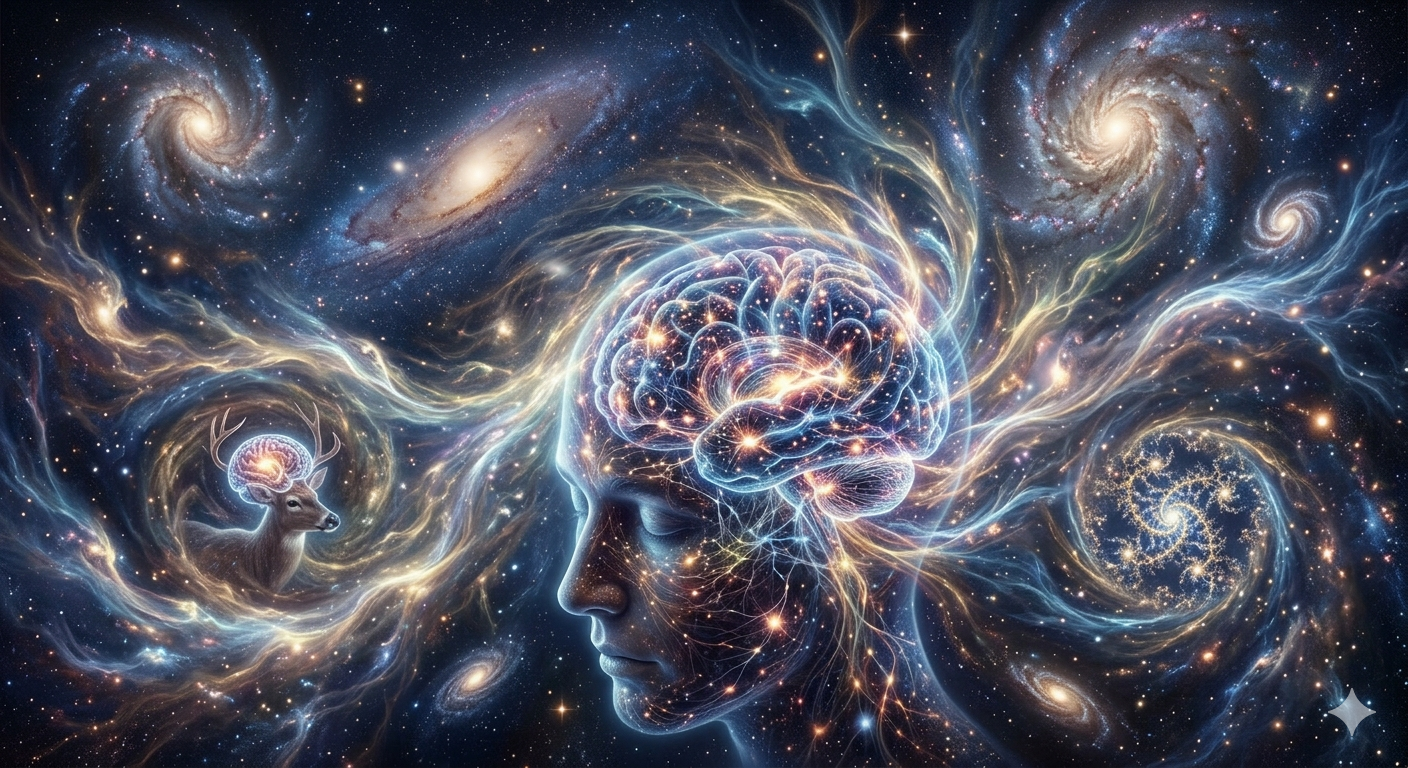
Building upon this critical distinction between phenomenal continuity and informational isolation, Continuism redefines what an individual mind actually is. Rather than being distinct, floating metaphysical orbs, individual subjects like humans and animals are understood as informationally dense regions operating within the broader phenomenal continuum. Within the physical structure of a human brain, billions of neurons are firing, looping, and exchanging massive quantities of highly organized data at astonishing speeds. This intense, localized whirlwind of cognitive processing agitates the local region of the conscious field, pulling it into a highly complex, highly structured “focal point” of subjective experience. It is precisely this overwhelming density and integrated structure of local information that generates the powerful, persistent illusion of being a completely separate and discrete self. In essence, the individual self is not a separate object cut out from the fabric of reality, but rather a temporary, localized pattern or whirlpool swirling dynamically within the singular ocean of universal consciousness.
Fully embracing this philosophical paradigm requires an intellectual dismantling of the common sense boundaries that dictate how we navigate our daily lives. The skin that encapsulates our bodies is biologically necessary for our survival, but Continuism insists that it is not a boundary line for the presence of consciousness. When you look out into the empty space of a room, your instinct tells you that the space is devoid of experience, serving merely as a void between solid, thinking objects. Continuist Panpsychism boldly contradicts this instinct, suggesting that the space between us is equally drenched in fundamental awareness, albeit in a form essentially devoid of the structured thoughts or sensory inputs we associate with human minds. The perceived edges of your subjective experience are merely the limits of your biological sensors, the physical horizons beyond which your nervous system can no longer reach or process data. Recognizing these boundaries as purely functional limitations rather than absolute metaphysical truths is essential to grasping the profound significance of the Continuist perspective.
Continuist Panpsychism naturally overlaps and deeply intertwines with another major theory in the philosophy of mind known as cosmopsychism. Cosmopsychism is essentially a top-down approach to universal consciousness, positing that the universe as a single, unified whole is the fundamental conscious entity, rather than microscopic particles. This does not mean that the universe necessarily possesses a cosmic “intellect” capable of complex thought and agency (although it does not explicitly deny this possibility), but simply that the universe as an indivisible whole is the overarching “seat” or holder of the unified conscious field. Continuism provides the necessary mechanical and structural explanation for how a cosmopsychist universe can possibly exist and function logically. If the cosmos is indeed one giant, macro-level consciousness, then the boundless, unbroken phenomenal field described by Continuism is the very mind of the universe itself. From this perspective, all the seemingly separate, individual consciousnesses we see on Earth are essentially partial, localized expressions or specialized cognitive functions occurring within the mind of the cosmos. The theories work together harmoniously, as Continuism explains the seamless medium, while cosmopsychism identifies the overarching entity to which that medium ultimately belongs.
The implications of this theory stretch far beyond academic debates, offering a radically different lens through which to view the phenomena of life, death, and personal identity. In traditional materialist frameworks, biological death represents the absolute annihilation of the conscious subject, the permanent extinguishing of a singular flame in a cold, dark universe. Under the Continuist model, death is conceptually transformed from an absolute ending into a process of dissolution and reintegration into the broader continuum. When the physical brain ceases to function and the complex informational loops break down, the informationally dense region that constituted the “self” gently unravels. However, the fundamental conscious awareness that undergirded that self is not destroyed, because that underlying phenomenal field is an indestructible feature of the universe itself. The localized whirlpool simply subsides back into the calm, peaceful ocean, losing its structured identity but never losing its intrinsic presence within the fabric of reality.
This interconnected, unbroken view of existence also carries profound existential and ethical weight for how we ought to treat one another and our surrounding environment. If we accept that we are all temporary, localized manifestations of the exact same continuous medium of consciousness, the sharp divisions between “self” and “other” begin to blur significantly. Such a perspective naturally fosters a deep sense of universal kinship, as the suffering or joy of another being is quite literally occurring within the same fundamental fabric that makes up your own mind. Empathy is no longer merely a psychological projection or a useful social tool, but rather a direct recognition of our shared, underlying metaphysical reality. Furthermore, this viewpoint encourages a profound respect for the natural world, as the environment is not lifeless matter to be exploited, but part of the living, experiencing continuum of which we are intimately a part. By internalizing the axioms of Continuism, humanity might find a compelling philosophical basis for global compassion, ecological stewardship, and a deeper appreciation for the sacredness of all existence.
In conclusion, Continuist Panpsychism stands as a monumental and fiercely creative contribution to the ongoing quest to understand the ultimate nature of the mind and the universe. By proposing a cosmos bound together by an unbroken, infinitely stretching field of phenomenal consciousness, Luke Roelofs has provided a robust solution to the seemingly insurmountable “combination problem.” The theory successfully balances the holistic unity of universal experience with the undeniable reality of our informational isolation, perfectly explaining why we feel like separate beings in an ultimately undivided world. Through the concepts of phenomenal unboundedness and informationally dense regions, we are given a logical vocabulary to discuss how localized selves emerge organically from a conscious cosmos. While it demands a radical departure from our everyday intuitions regarding boundaries and individuality, the structural elegance and explanatory power of the theory make it a deeply compelling alternative to traditional dualism and materialism. Ultimately, Continuism invites us to gaze outward at the universe not as outsiders looking at a cold, mechanical void, but as intrinsic, deeply embedded assets of a spectacularly unified, continuously experiential reality.
Click here to return to the home page.
Copyright © 2026 David Clearwater