The Inevitability
of Human Progress
An Introduction
to Historical
Cultural Agathism
by David Clearwater
aided by Google Gemini
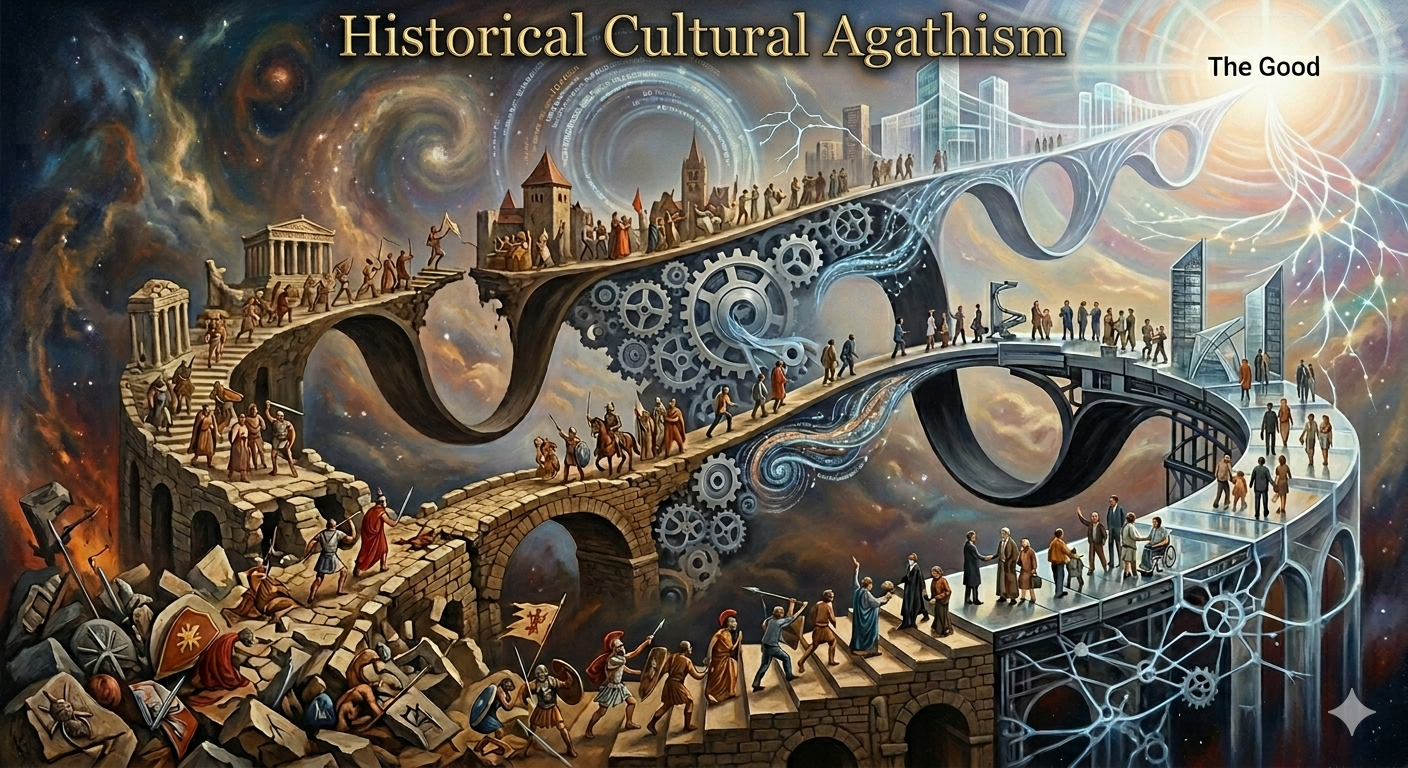
Throughout the vast and turbulent expanse of human history, observers have often struggled to find a cohesive narrative amidst the rise and fall of empires, the cycles of war and peace, and the constant shifting of societal norms. Some look at the past and see a tragic cycle of inevitable decline, while others subscribe to a blind optimism that everything is inherently fine just as it is. Historical Cultural Agathism emerges as a profound and realistic alternative to these extremes. At its core, Historical Cultural Agathism postulates that human civilization and culture deterministically trend toward an ultimate moral good over time, even though humanity routinely takes significant backward steps along the way. It is a philosophy of structural hope, grounded not in magical thinking, but in the observable mechanics of how human societies evolve, learn, and adapt.
To understand this philosophy, one must first recognize the deliberate use of the term agathism (from the Greek root agathos—meaning “good”), which is typically defined as “the belief in an outcome that is ultimately good, even though evil or misfortune may intervene.” Unlike optimism, which suggests that the current state of the world is inherently good or the best it could possibly be, agathism acknowledges the presence of profound suffering, failure, and evil in both the past and the present. It does not demand that we ignore the tragedies of history. Instead, it asserts that the ultimate destination of human cultural evolution is intrinsically good. It is a framework that allows us to look unblinkingly at the darkest chapters of the human story while maintaining the logically sound conviction that the overarching, macro-level trajectory of our species bends toward moral progress.
A foundational axiom of Historical Cultural Agathism is its definition of “the Good.” In this framework, the Good is not a concrete, strictly defined utopian blueprint or a specific set of moral laws known to humanity today. Rather, it is an abstract concept representing an ultimate moral principle toward which human culture is continually evolving. It acts as an asymptotic horizon. Because human society is constantly growing in complexity, the Good can never be definitively defined, nor can it ever be finally reached or perfectly attained in the future. As humanity progresses, its moral frontier continuously shifts outward. Every time a society crosses a previous moral threshold, its conceptual horizon expands, revealing deeper and more nuanced layers of ethical responsibility that were previously invisible. Therefore, the Good is not a static endpoint, but a philosophical representation of the infinite trend of human progress.
Crucially, Historical Cultural Agathism does not rely on any metaphysical, supernatural, or divine forces to pull humanity forward. The upward trend is entirely driven by observable material realities, including historical, cultural, psychological, and societal forces. It relies on the cognitive ratchet of cumulative learning, where societies slowly figure out that cooperation, human rights, and high-trust institutions are simply more efficient and sustainable than zero-sum tyranny and brutal exploitation. It is driven by an expanding psychological circle of empathy, forged through global connection, trade, and communication, which forces humanity to continually broaden its definition of who deserves protection. The philosophy observes that moral progress is a supreme survival strategy for a highly complex, social species.
Furthermore, this upward trend operates deterministically rather than voluntarily. Historical Cultural Agathism proposes that civilization gravitates toward the Good regardless of whether the people within that civilization are consciously aware of the trajectory or actively trying to achieve it. This is not a declaration of strict physical determinism where free will does not exist, but rather a sociological determinism where the Good is an emergent property of a complex system. Individuals may act selfishly, leaders may act destructively, and entire nations may lose their way, but the decentralized macro-machinery of human culture is structurally rigged to distill those chaotic inputs into a long-term upward trend. A society that implements deeply irrational or immoral systems inevitably creates internal friction and instability, naturally forcing a correction over the long arc of time.
Because human history is a decentralized, self-evolving system without a top-down controlling architect, it is inherently chaotic. This randomness is the exact cause of the temporary setbacks and regressions that litter the historical record. However, in Historical Cultural Agathism, these backward steps are not anomalies or failures of the trend; they are a vital, constitutive part of the upward climb. Humanity rarely discovers a better moral framework through pure, detached reasoning. Instead, we learn through the via negativa (the “negative path”), discovering what is good by experiencing the catastrophic pain of what is bad. When the randomness of the system produces a devastating setback, humanity learns what not to do. These painful regressions provide the necessary stress-tests and data points required to build stronger, more empathetic, and more resilient societal structures in the aftermath.
Historical Cultural Agathism is also deeply realistic about the ultimate vulnerability of the human species. It openly acknowledges that total extinction is a very real possibility, whether through environmental collapse, nuclear conflict, or other catastrophic events. It does not promise immortal salvation. However, it maintains a principle of conditional gravity. If humanity were to face a near-extinction event but managed to survive, the resulting dark age would be viewed as just another setback, albeit a massive one. While centuries of progress might be lost, the underlying laws of cultural evolution would remain entirely intact. From that new, devastated baseline, the surviving fragments of humanity would once again be subject to the deterministic forces of cooperation and rationality, and the species would inevitably resume its slow, upward trend toward the Good.
Ultimately, Historical Cultural Agathism offers a resilient, hopeful, yet intellectually rigorous lens through which to view human existence. It strips away the fragility of utopian thinking while refusing to surrender to nihilism. By accepting that setbacks are the brutal but necessary classrooms of civilization, and by recognizing that our progress toward an unknowable Good is a deterministic feature of our collective evolution, we are freed to view the story of humanity not as a tragedy of errors, but as a magnificent, self-correcting ascent.
Click here to return to the home page.
Copyright © 2026 David Clearwater